
But What Kind of Adoption Are We Actually Measuring?
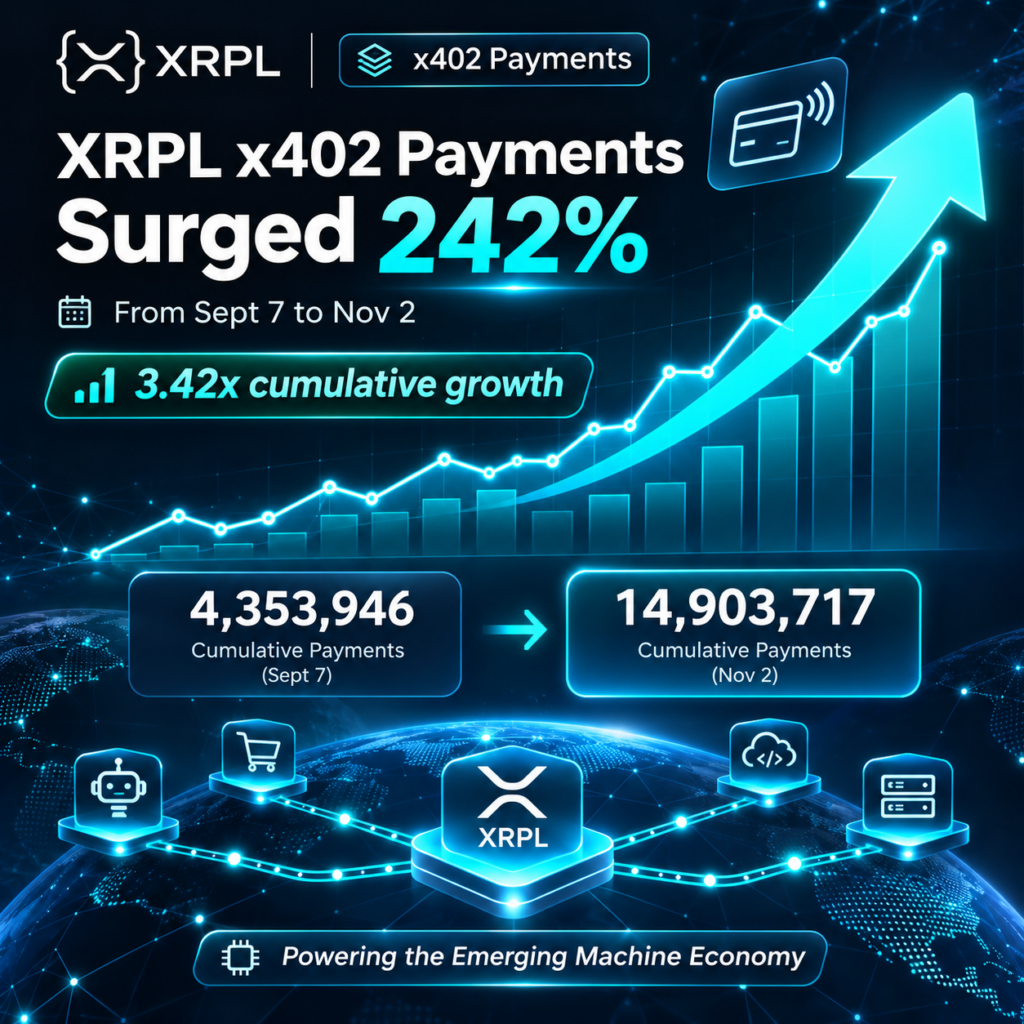
I’ve been tracking XRPL’s x402 payment activity since September, and the numbers deserve attention. The article I wrote (x402 Surge) can be found here. But I believe we’re approaching a point where transaction growth alone is no longer enough to measure the kind of adoption taking place.
In my September 7 article, XRPL’s x402 Surge: The Machine Economy Is Taking Shape, I examined XRPL’s early growth and raised a question that remains central to my research:
Are autonomous AI agents actually selecting XRPL over competing payment networks?
My earlier article, Ripple Is Expanding the XRP Ledger in Two Directions, explains why agentic payments matter within my broader Ripple Stack thesis. As a brief reminder: My September 7 article already examined competing networks and their inconsistent measurement methodologies.
Today, I’m taking that analysis one step further.
The Growth Is Significant
Between September 7 and November 2, 2026, the XRPL x402 dashboard figures I recorded show:
- September 7: 4,353,946 cumulative payments
- November 2: 14,903,717 cumulative payments
- Increase: 10,549,771 payments
- Growth: Approximately 242%
- Multiplier: 3.42 times the previous cumulative total
That’s substantial growth in fewer than two months.
It demonstrates a significant expansion in the payment activity reported by the XRPL x402 infrastructure.
However, a 242% increase in cumulative transactions does not automatically mean a 242% increase in independent customers, commercial demand, or autonomous AI adoption.
Those are different measurements.
And understanding those differences is essential.
What We Can Measure Today
Based on currently available public dashboard data, we can evaluate:
- Payment activity: Reported cumulative payments and changes between dated observations.
- Settlement value: Reported aggregate value transferred through the tracked infrastructure.
- Merchant participation: The number of merchant endpoints or services identified by the dashboard.
- Growth trends: Changes in transaction counts and reported activity over time, subject to consistent data collection.
These are meaningful indicators of infrastructure utilization.
They demonstrate that XRPL is being used for this emerging payment category. But they cannot independently tell us whether that activity represents testing, developer-directed automation, paying customers, or autonomous competitive network selection.
Transaction activity is measurable. The economic and decision-making behavior behind every transaction is not.
What We Cannot Yet Measure Reliably
Several critical questions remain unanswered by the available aggregate data.
1. How much represents genuine commercial adoption?
We cannot reliably distinguish production customer payments from developer testing, repeated automated requests, internal transactions, or promotional activity.
What’s missing: Verified production transaction records, independent paying-customer counts, test-versus-production labels, and merchant revenue data.
2. How much represents autonomous AI decision-making?
A developer might configure an application to use XRPL exclusively. Alternatively, an AI agent might evaluate XRPL, Base, Solana, and other networks before selecting the most appropriate payment rail.
Both scenarios could generate identical-looking XRPL transactions.
What’s missing: Agent decision logs showing available networks, selection criteria, and which network the agent independently chose. Here’s a link to the XRPL AI Data Hub for your own reference.
3. Is XRPL winning payment activity from competing networks?
We cannot reliably establish whether XRPL’s growth reflects increased market share, entirely new demand, or payment traffic directed there by developers.
What’s missing: Standardized, comparable cross-network reporting that distinguishes total activity from competitive network selection.
4. What does the growth mean for XRP and RLUSD?
Payment counts alone cannot establish the economic demand generated for either asset, nor how much of the activity creates recurring XRP utilization beyond network fees.
What’s missing: Reconciled asset-specific settlement records, recurring customer payment volume, XRP network-fee measurements, and liquidity requirements.
These limitations do not invalidate the growth. They define what the available evidence can support.
Four Practical Levels of Adoption
I believe we need to distinguish four different levels when evaluating XRPL’s progress.
Level 1 — Infrastructure Adoption
Developers integrate XRPL’s payment capabilities into their applications.
Level 2 — Automated Utilization
Software executes payments over XRPL, whether for testing or real economic transactions.
Level 3 — Programmatic Network Selection
Applications choose XRPL using predefined routing logic, policies, or programmed criteria.
Level 4 — Autonomous AI Network Selection
An AI agent evaluates multiple viable networks and independently selects XRPL based on cost, speed, liquidity, reliability, or other operational requirements.
Each level represents something different.
An application can reach Level 2 without proving Level 3 or Level 4. And a payment executed automatically does not necessarily mean an AI agent independently selected its network.
The public activity data supports infrastructure utilization and automated payment activity. It does not yet establish how much of that activity reaches Levels 3 or 4.
Importantly, this doesn’t mean autonomous agents aren’t choosing XRPL.
It means we currently lack the evidence needed to determine how often that choice is actually occurring.
How Do We Obtain the Missing Data?
The answers will require greater transparency from facilitators, developers, application operators, and participating merchants.
I would like to see standardized reporting that includes:
- Facilitator data: Production versus testing transactions, unique paying participants, and reconciled settlement volumes.
- Developer and client data: Whether payment routes were fixed, selected through programmed logic, or chosen by autonomous agents.
- Agent decision telemetry: Which networks were available, what criteria were evaluated, and which network was ultimately selected.
- Cross-network measurements: Comparable transaction, customer, and settlement data using the same methodology across XRPL, Base, Solana, and other networks.
Sensitive customer information does not need to become public. Aggregated, anonymized, independently verifiable reporting could provide much of what researchers need.
One metric I’d particularly like to see developed is the Autonomous XRPL Selection Rate:
Verified autonomous selections of XRPL ÷ all verified autonomous selections among eligible competing networks × 100.
That would help measure something far more informative than raw transaction growth: how frequently independently operating AI agents prefer XRPL when they have a genuine choice.
Of course, that measurement would require evidence that multiple networks were actually available and that an autonomous decision—not a developer restriction—determined the route.
Where I Stand
I consider a 242% increase in reported cumulative XRPL x402 payments significant.
I also believe it’s entirely possible that some portion of this growth reflects autonomous AI agents choosing XRPL over competing networks.
We cannot reasonably rule that possibility out simply because developers can hard-code their network selections. But we cannot quantify it from the current public data either.
The same uncertainty applies when evaluating automated payment activity on Base, Solana, or any competing network.
That is precisely why I believe the next stage of x402 adoption research needs to focus less on headline transaction counts and more on the behavior generating those transactions.
We have evidence of expanding XRPL x402 utilization. What we need now is greater visibility into who is using it, why they’re using it, and whether autonomous systems are choosing it competitively.
As facilitators, developers, and merchants make more of that information available, we can move from measuring transaction activity toward measuring genuine commercial adoption and autonomous network preference.
I encourage other researchers to examine the publicly available data, challenge the methodology, and push for better reporting.
One distinction worth preserving in future research: autonomous network selection and genuine commercial adoption are separate dimensions. An AI can independently choose a network for a test transaction, while a developer-configured payment can represent legitimate customer revenue. Neither measurement should substitute for the other.
The numbers are telling us something important.
Our next responsibility is determining exactly what they’re telling us.
Data note: Figures reflect dated observations of the XRPL x402 dashboard and should be understood as reported, indexed activity rather than independently audited totals. The September 7 observation differs slightly from the subsequently published figure in my original article because dashboard readings were taken at different times.
Research references: XRPL AI Hub | Original September 7 analysis | Ripple Stack background