
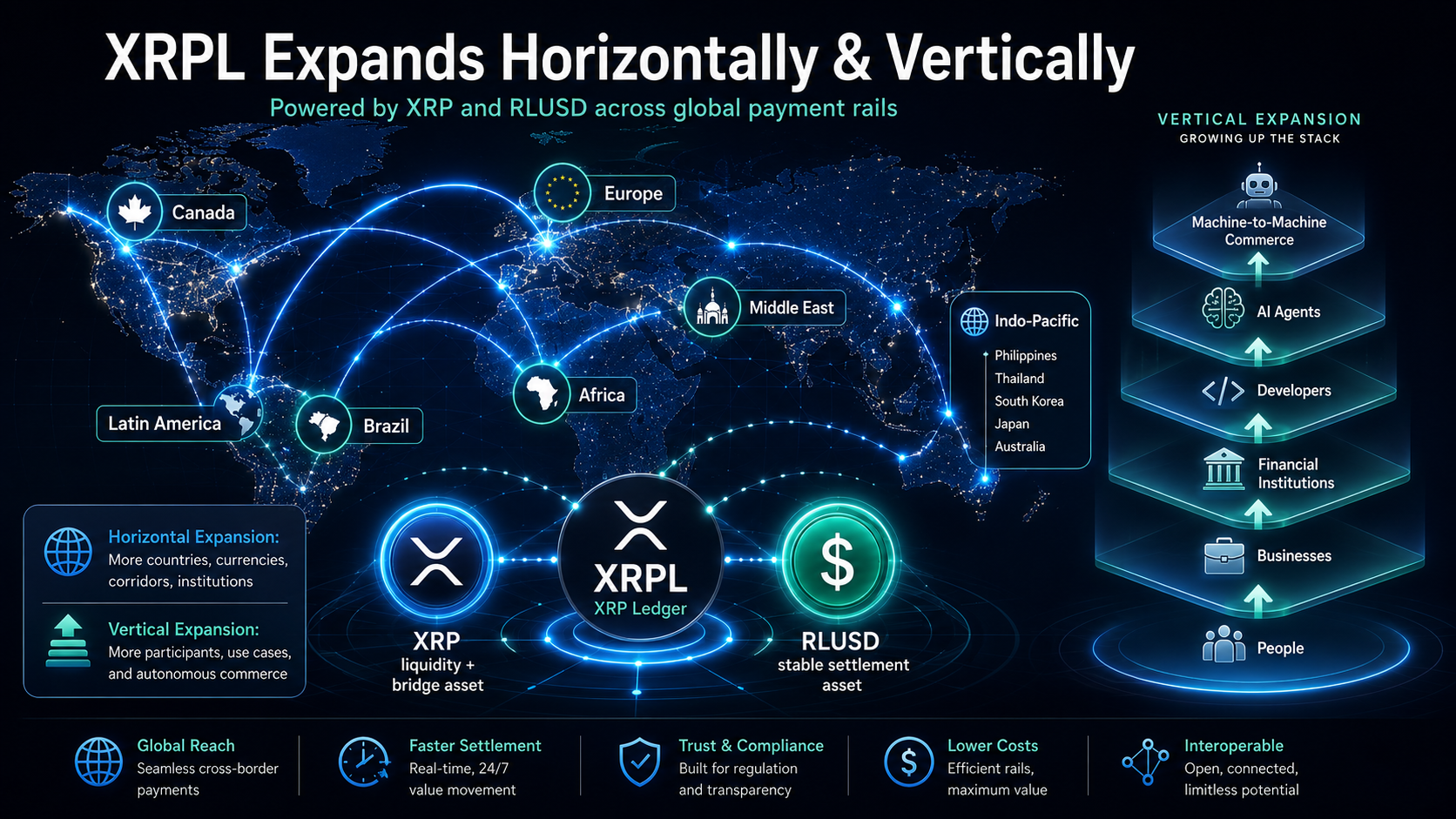
The more I study Ripple’s expansion across Africa, Latin America, Europe, the Middle East and the Indo-Pacific, the more convinced I become that these developments are not isolated announcements.
They appear to be different pieces of one much larger ecosystem strategy.
Ripple is expanding the XRP Ledger in two directions simultaneously:
Geographically, by connecting more countries, currencies, financial institutions, payment providers, custody partners, mobile-money platforms, developers and payment corridors.
Technologically, by expanding who—or what—can initiate, receive and settle a transaction.
Until recently, most discussions surrounding XRPL adoption focused on:
• Individuals sending remittances
• Businesses settling invoices
• Financial institutions moving liquidity
• Fintech companies integrating payments
• Developers building XRPL applications
However, Ripple’s XRPL AI Starter Kit and its support for the x402 payment standard introduce another major category:
Autonomous AI agents capable of initiating, receiving and settling payments without a human manually approving every individual transaction.
That significantly expands the XRP Ledger’s potential addressable market.
━━━━━━━━━━━━━━━━━━
RIPPLE IS EXPANDING THE RAILS HORIZONTALLY
Ripple’s geographic expansion potentially creates:
• More countries
• More currencies
• More regulated institutions
• More payment corridors
• More custody endpoints
• More mobile-money connections
• More stablecoin access points
• More developers and applications
• More on-ramps and off-ramps
• More institutional liquidity
This expansion can already be seen across several strategically important regions.
━━━━━━━━━━━━━━━━━━
AFRICA EXPANDS THE MOBILE-MONEY AND REMITTANCE OPPORTUNITY
Africa already possesses an enormous mobile-money ecosystem, with a population that is increasingly accustomed to using mobile devices as financial tools.
Ripple is simultaneously developing relationships involving:
• Cross-border payments
• Digital-asset custody
• Institutional compliance
• Stablecoins
• Financial institutions
• Liquidity and settlement
The Absa Bank custody relationship is particularly important because regulated custody can provide institutions with the security and compliance framework necessary to participate in the digital-asset economy.
However, custody should not necessarily be viewed as the final destination.
Custody can become an institutional entry point into Ripple’s broader ecosystem of payments, liquidity, stablecoins, tokenization and XRPL-based applications.
Over time, XRPL-connected services in Africa could potentially support:
• Cross-border remittances
• Automated currency conversion
• Agricultural supply-chain payments
• Microinsurance premiums
• International e-commerce
• Automated invoice settlement
• Mobile airtime and utility payments
• Freight and logistics settlement
• Contractor and gig-worker payments
• Digital identity and document services
A user may experience this as a simple mobile transaction.
Behind the scenes, however, an automated system could be comparing rates, selecting liquidity, converting currencies and completing settlement through an XRPL-connected payment path.
That is where Ripple’s African expansion and its agentic-payment technology could eventually begin reinforcing one another.
━━━━━━━━━━━━━━━━━━
BRAZIL AND LATIN AMERICA HELP CREATE THE BUILDERS
Ripple’s UDAX accelerator initiative in Brazil brings developers, startups, institutional experiments and new applications into the XRP Ledger ecosystem.
That matters because infrastructure alone does not create adoption.
Developers must build the products, applications and services that people, businesses and financial institutions actually use.
The XRPL AI Starter Kit gives those developers another powerful set of capabilities.
A Brazilian startup could potentially create an autonomous treasury agent that:
• Monitors company balances
• Pays invoices using RLUSD
• Converts currencies when necessary
• Settles with international suppliers
• Enforces corporate spending limits
• Records every payment onchain
• Reconciles transactions automatically
Another developer could create an AI agent that purchases computing power, data, API access or another digital service one request at a time through x402.
Another could build an agricultural-finance application in which payments are automatically triggered once shipping, inspection or delivery conditions are satisfied.
Programs such as UDAX help create the builders, while the XRPL AI Starter Kit expands what those builders can create.
━━━━━━━━━━━━━━━━━━
THE INDO-PACIFIC PROVIDES A MAJOR INSTITUTIONAL AND CROSS-BORDER CORRIDOR
The Indo-Pacific must also be included in this larger picture.
Ripple generally describes its commercial operations in this part of the world as the Asia-Pacific region, or APAC. However, that activity fits within the broader Indo-Pacific framework, connecting major markets across the Indian and Pacific Oceans.
The region includes some of the world’s largest financial centers, trade corridors, remittance markets, technology sectors and digitally engaged populations.
Ripple’s presence in this region is not limited to a single country or product.
It includes activity involving:
• Singapore
• Australia
• Japan
• South Korea
• Southeast Asia
• Regional remittance corridors
• Institutional custody
• RLUSD distribution
• Cross-border payments
• Trade-finance settlement
• Academic and developer ecosystems
Singapore serves as Ripple’s Asia-Pacific headquarters. Ripple’s Singapore subsidiary holds a Major Payment Institution license from the Monetary Authority of Singapore, and that license’s approved scope was expanded in December 2025, allowing Ripple to broaden its regulated payment offerings in the country. ially important because it can function as:
• A regulatory hub
• A regional payments center
• A digital-asset innovation center
• A connection point between financial institutions
• A base for serving customers across the broader region
Ripple has also participated in the Monetary Authority of Singapore’s BLOOM initiative. Through its partnership with Unloq, an XRPL-based trade-finance solution can use RLUSD to automatically trigger payments when shipment conditions are verified.
That is a real-world example of how tokenized value, stablecoins, programmable conditions and international trade could begin converging on XRPL infrastructure. assents another important part of Ripple’s regulated expansion.
In March 2026, Ripple announced plans to strengthen its Australian licensing position and expand Ripple Payments for financial institutions, fintech companies and enterprises seeking more efficient cross-border movement of value. Ripple’s regulatory disclosures now identify Ripple Payments Australia as holding an Australian Financial Services License. ts another major component.
In June 2026, Ripple and SBI Group officially launched RLUSD in Japan following the applicable regulatory approval. That development builds upon a relationship between Ripple and SBI that stretches back approximately a decade and has focused on digital-asset and blockchain-based financial infrastructure across Japan and the broader Asia-Pacific region. history of Ripple-connected remittance activity.
SBI Remit and its regional partners have used Ripple technology for payment corridors connecting Japan with countries such as Thailand and the Philippines. Those corridors demonstrate how Ripple’s infrastructure can connect developed financial markets with high-demand remittance destinations across the Indo-Pacific. ds the institutional-custody component.
In April 2026, Ripple announced a partnership with Kbank, South Korea’s first internet-only bank, to deploy Ripple Custody’s institutional digital-asset wallet infrastructure.
That partnership connects Ripple’s custody technology to a regulated Korean banking institution and further demonstrates that Ripple is not expanding through payments alone. It is also creating infrastructure for institutions to securely manage digital assets.
Specific opportunity could eventually include:
• Cross-border remittances
• Institutional treasury movement
• Regional currency conversion
• Trade-finance settlement
• Import and export payments
• Stablecoin-based settlement
• Digital-asset custody
• Corporate liquidity management
• Tokenized financial assets
• AI-agent payments
• Machine-to-machine commerce
This region is particularly important because it contains highly developed financial centers alongside rapidly growing emerging markets.
That creates demand for infrastructure capable of connecting:
• Different currencies
• Different regulatory systems
• Different banking environments
• Different levels of financial access
• Different payment and remittance needs
The Indo-Pacific therefore provides Ripple with something extremely valuable:
A massive collection of potential payment corridors connecting advanced financial markets, developing economies, global trade centers and digitally active populations.
━━━━━━━━━━━━━━━━━━
AGENTIC PAYMENTS EXPAND WHO CAN USE THE RAILS
Ripple’s regional expansion adds countries, institutions and payment corridors.
Agentic payments expand the network in another direction by increasing the types of participants capable of using those corridors.
Under the x402 model, an AI agent could request access to:
• An API
• A dataset
• An AI model
• Computing capacity
• Software functionality
• A digital subscription
• Another machine-provided service
The service responds that payment is required.
1. Checks the amount against its authorized spending limit
2. Pays using XRP or RLUSD
3. Receives a definite transaction result from XRPL
4. Gains access to the requested service
5. Records the transaction for accounting and auditing
No credit-card form.
No conventional account creation.
No waiting for banking hours.
No person manually approving every small purchase.
This introduces the possibility of:
• Human-to-human payments
• Human-to-business payments
• Business-to-business payments
• Institution-to-institution settlement
• Human-to-agent payments
• Agent-to-business payments
• Agent-to-agent payments
• Machine-to-machine commerce
AI agents will need to purchase computing resources, data, software access and digital services while performing assigned tasks.
Those agents require payment infrastructure that is:
• Fast
• Inexpensive
• Predictable
• Programmable
• Auditable
• Available around the clock
XRPL’s settlement characteristics and definite transaction outcomes are particularly useful in that environment.
Software needs to know:
“Was the payment completed, how much did it cost, and may I proceed to the next task?”
A transaction system designed to confirm or cleanly reject a payment can provide that answer.
━━━━━━━━━━━━━━━━━━
WHY XRPL’S BUILT-IN CONTROLS MATTER
Giving autonomous software access to money naturally creates concerns involving unauthorized spending, permissions and accountability.
A corporation or financial institution is unlikely to give an unrestricted AI program unlimited access to its treasury.
However, it may allow an agent to operate within a tightly controlled wallet containing:
• A defined spending balance
• Approved assets
• Approved counterparties
• Daily limits
• Per-transaction limits
• Multi-signature approval above certain amounts
• Full transaction attribution
• A permanent, auditable on-chain record
XRPL provides features such as:
• Multi-signature authorization
• Escrow
• Deposit authorization
• Trust lines
• Source tags
• Memo fields
• Time-based restrictions
• Approval structures
These tools could help an organization determine:
• Who an agent may pay
• Which assets it may use
• How much it may spend
• Which transactions require additional approval
• How every transaction is identified and audited
This is where Ripple Custody, compliance infrastructure and XRPL’s agentic-payment capabilities could eventually complement one another.
Ripple Custody helps institutions control the assets.
XRPL provides the settlement infrastructure.
AI agents operate within predefined permissions.
Every transaction remains attributable and auditable.
━━━━━━━━━━━━━━━━━━
RLUSD AND XRP CAN SERVE DIFFERENT PURPOSES
RLUSD and XRP do not necessarily have to compete with one another.
They can perform different but complementary functions.
RLUSD provides dollar-denominated stability.
That makes it particularly suitable for:
• Invoices
• Payroll
• Subscriptions
• API purchases
• Computing services
• Data purchases
• Trade settlement
• Agent-to-agent commerce
An AI agent purchasing a $5 digital service generally benefits from knowing that the payment asset is designed to maintain a stable dollar value.
XRP, meanwhile, can function as:
• The native asset of the XRP Ledger
• A direct payment asset
• A source of native liquidity
• A bridge between currencies
• An intermediary between issued assets
• An asset used within XRPL payment routing
Not every agentic transaction will necessarily use XRP.
Some transactions may simply move RLUSD from one XRPL account to another.
However, XRP may become relevant whenever bridging, liquidity or currency conversion provides the most efficient payment route.
That is the honest—but still bullish—interpretation.
Agentic commerce does not guarantee that every machine transaction will create substantial direct XRP demand.
What it does is increase the number of:
• Participants
• Applications
• Transactions
• Currencies
• Issued assets
• Payment corridors
• Liquidity routes
…operating through the XRP Ledger.
That naturally increases the number of situations in which XRP could be used directly or as an intermediary liquidity asset.
━━━━━━━━━━━━━━━━━━
THE FULL RIPPLE STACK
When everything is viewed together, Ripple’s strategy appears to contain several interconnected layers:
Regulatory clarity gives institutions permission and confidence to participate.
Ripple Custody and compliance infrastructure allow institutions to securely hold and manage digital assets.
Ripple Payments connect(s) financial institutions, businesses and international payment corridors.
RLUSD provides stable, dollar-denominated settlement.
XRP provides native liquidity, bridging and payment-routing functionality.
XRPL provides the underlying payment, exchange, tokenization and settlement infrastructure.
Regional expansion across Africa, Latin America, Europe, the Middle East and the Indo-Pacific creates additional regulated endpoints and corridors.
Developer programs such as UDAX help create new applications and businesses.
The XRPL AI Starter Kit and x402 allow autonomous agents to transact through those applications and payment rails.
This is the full-stack strategy I have been discussing.
Ripple is helping construct:
The tracks
The stations
The trains
The cargo
The ticketing system
The custody, security and regulatory controls
The international corridors
And now, autonomous operators capable of directing transactions across the network
The progression could eventually look like this:
Ripple establishes regulated operations across additional regions
Banks, custody providers and payment companies establish institutional access
Developers build applications and financial services on XRPL
Those applications connect individuals, companies and institutions to the network
Stablecoins, tokenized assets and currencies move through those applications
AI agents begin initiating transactions through the same infrastructure
XRPL processes both human-initiated and machine-initiated economic activity
That represents a much larger potential market than remittances alone.!.!.!
━━━━━━━━━━━━━━━━━━
THE BIGGER PICTURE
Ripple is not simply attempting to create a faster version of the existing financial system.
It appears to be positioning the XRP Ledger as infrastructure for an environment in which:
• People
• Businesses
• Banks
• Payment companies
• Mobile-money platforms
• Applications
• Stablecoins
• Tokenized assets
• Institutional treasury systems
• Autonomous AI agents
…can all move value across the same underlying network.
Africa provides mobile-money users, remittance demand, developing payment corridors and new institutional endpoints.
Brazil and Latin America provide developers, expanding digital-payment markets and new applications.
Europe provides regulated institutional access through comprehensive digital-asset frameworks.
The Middle East provides strategically important financial centers, international trade corridors and growing digital-asset infrastructure.
The Indo-Pacific provides Singapore’s regulatory and payments hub, Australia’s regulated expansion, Japan’s SBI relationship and RLUSD distribution, South Korea’s institutional-custody development and numerous cross-border trade and remittance corridors.
Ripple Custody and compliance provide institutional trust and control.
RLUSD provides stable settlement value.
XRP provides native liquidity, bridging and payment-routing capabilities.
The XRPL AI Starter Kit and x402 add an autonomous transaction layer.
Combined, these initiatives widen Ripple’s payment rails both:
Geographically and Technologically
That is why I do not view Ripple’s announcements as a collection of unrelated partnerships, licenses and products.
I view them as pieces of a coordinated strategy to position XRPL as potential settlement infrastructure for an emerging global, tokenized and machine-to-machine economy.
Africa matters. Brazil and Latin America matter. Europe matters. The Middle East matters. And the Indo-Pacific absolutely matters.
Each region adds institutions, currencies, developers, users, liquidity and payment corridors to the broader network.
In my opinion, the market still does not fully understand how large that network—or the opportunity surrounding it—could eventually become.
For more articles I’ve written regarding Ripple, XRP Ledger, RLUSD or Ripple’s XRP Token, you can find them here.