
Why This Could Be a Major Step Toward the XRP’s Long-Term Utility Thesis I have been building
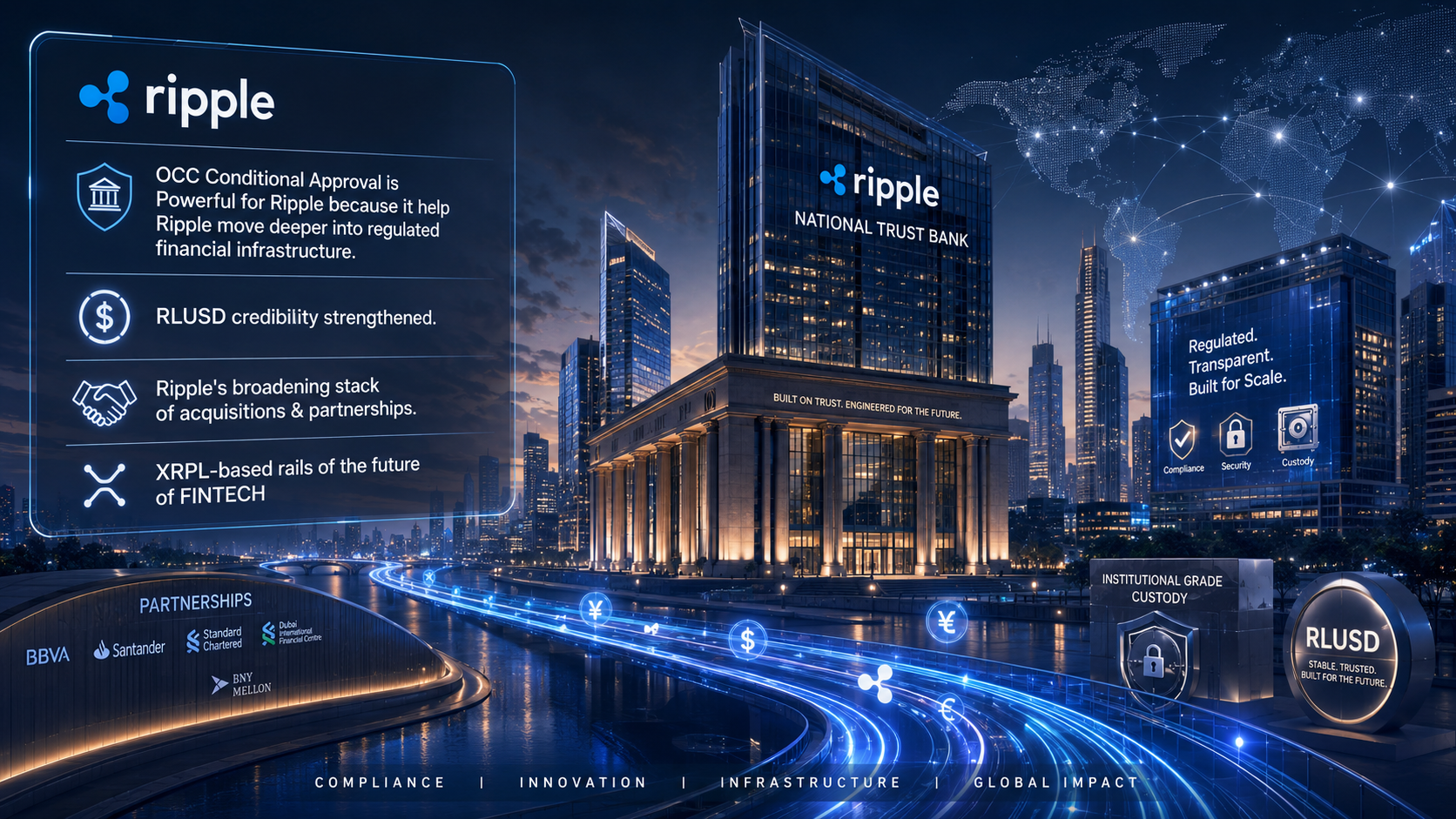
Ripple’s conditional approval from the Office of the Comptroller of the Currency for Ripple National Trust Bank is not just another regulatory headline. In my opinion, it is another major piece of the larger foundation Ripple has been building for years.
The short version is this:
Ripple is not simply building a payment app, a stablecoin, or a crypto custody business. Ripple is building a regulated financial infrastructure stack.
That stack appears designed to support institutional payments, stablecoin settlement, digital asset custody, treasury operations, liquidity management, prime brokerage, and eventually broader XRP/XRPL adoption across fintech and banking use cases.
The OCC’s conditional approval matters because it gives Ripple a path toward federal trust-bank supervision. The OCC stated that Ripple National Trust Bank received preliminary conditional approval, but final authorization to open still depends on Ripple satisfying the OCC’s pre-opening requirements. The OCC also described the planned activities as including fiduciary services, RLUSD reserve-related services, and digital asset custody.
That is why this is bigger than “Ripple got a bank charter.” The real point is that Ripple is building a more credible, regulated institutional gateway into digital asset settlement.
The Better Framing
The better framing is not: “OCC approval instantly makes XRP go up.”
The better framing is:
“OCC approval strengthens Ripple’s regulated infrastructure stack, which makes Ripple more credible to U.S. fintechs, payment companies, institutions, and eventually banks. As more entities use RLUSD and XRPL-based rails instead of slower or more expensive legacy rails, more value can flow onto the XRPL. Over time, that can encourage larger XRP accumulation for liquidity, treasury, settlement, and reserve-style use cases. That reduces available float and can support significant price appreciation from now through 2030 and beyond.”
That is the larger XRP thesis.
This is not a transaction-fee burn thesis. The XRP fee burn exists, but that is not the big story. The big story is inflows, utility, institutional adoption, XRP accumulation, and float compression.
Explain It Like I’m Five (ELIF)
Imagine the old financial system is like sending money through a long line of people, each person passing a note to the next person.
One person checks the note.
Another person moves the money.
Another person converts the currency.
Another person confirms settlement.
Another person reconciles the books.
Each person takes time and may charge a fee.
That is similar to how much of the old cross-border system works. SWIFT is very important, but SWIFT is mainly a messaging layer. It helps banks communicate payment instructions, but the actual settlement, liquidity movement, currency conversion, and reconciliation can still involve multiple intermediaries.
Ripple’s bigger idea is different.
Ripple is trying to build a system where value can move more directly, more quickly, and with regulated digital assets. RLUSD can act as the compliant digital dollar. XRPL can act as a fast settlement rail. XRP can act as the liquidity/routing/settlement asset within that broader system where regulations and market structure allow.
So the OCC approval helps because it makes Ripple look less like “just a crypto company” and more like a regulated financial infrastructure provider.
For fintech companies, that matters.
A fintech company does not only ask, “Is this faster?”
They ask, “Can our lawyers approve it?”
They ask, “Can our banking partners accept it?”
They ask, “Can our auditors understand it?”
They ask, “Can regulators see who is supervising this?”
They ask, “Is the reserve and custody structure credible?”
Ripple National Trust Bank helps answer those questions.
How This Helps Ripple’s Stack
Ripple’s stack is becoming more than one product. It is becoming a layered financial system.
1. XRPL: The Settlement Foundation
The XRP Ledger is the base settlement network. XRPL is designed for fast, low-cost value movement and has been operating for more than a decade. XRPL.org describes it as a decentralized public blockchain built for value creation, streamlined development, low transaction costs, high performance, and sustainability.
For Ripple’s bigger picture, XRPL is the rail.
It is where tokenized value, stablecoins, institutional payments, and liquidity can move. XRP is the native asset of that ledger. Ripple states that XRP facilitates network transactions, helps protect the ledger from spam, and can bridge currencies through the XRPL decentralized exchange.
That is why XRP matters in this thesis. Not because tiny burns alone create massive value, but because deeper institutional use of XRPL can increase the need for XRP as liquidity, routing, settlement, collateral, and treasury inventory.
2. RLUSD: The Compliant Dollar Layer
RLUSD is Ripple’s dollar stablecoin. Ripple says RLUSD is designed to maintain a one-dollar value, is issued on both XRPL and Ethereum, is backed by segregated reserves of cash and cash equivalents, and is redeemable 1:1 for U.S. dollars.
RLUSD matters because many U.S. fintechs and institutions may be more comfortable using a regulated digital dollar than directly holding XRP at first.
That does not weaken the XRP thesis. It may actually strengthen it.
RLUSD can be the front-facing dollar instrument that brings institutions into Ripple’s ecosystem. Once more value is moving through Ripple’s rails, XRP’s role as the native liquidity and settlement asset becomes more important over time.
In other words:
RLUSD can help onboard the regulated world. XRP can benefit as the network’s liquidity and settlement role expands.
3. Ripple National Trust Bank: The Federal Trust Anchor
This is where the OCC approval becomes important.
The OCC approval gives Ripple a path toward a federally supervised trust-bank entity. The Ripple-specific OCC approval discusses activities tied to fiduciary services, collateral trustee functions, RLUSD reserve-related services, and digital asset custody.
That means Ripple is not just saying, “Trust our stablecoin.”
Ripple is building a structure where RLUSD reserve management, custody, and fiduciary functions can sit inside a federally supervised trust-bank framework if Ripple satisfies the OCC’s final requirements.
That matters to fintechs because regulated trust infrastructure lowers the perceived risk of using Ripple’s rails.
4. Metaco: Institutional Custody Technology
Ripple acquired Metaco in 2023 for $250 million. Ripple described Metaco as a provider of digital asset custody and tokenization technology, and said custody is a key infrastructure requirement for enterprise crypto services.
This acquisition was pivotal because institutions cannot participate seriously in digital assets without custody.
Banks, asset managers, fintechs, and large enterprises need secure ways to hold, issue, manage, and settle tokenized assets. Metaco gave Ripple a custody technology layer that can serve institutional clients.
In the broader stack:
Metaco helps institutions safely hold digital assets.
That is essential if XRP, RLUSD, tokenized assets, or other digital instruments are going to be used at scale.
5. Standard Custody: Regulated Custody and Stablecoin Infrastructure
Ripple completed its acquisition of Standard Custody & Trust Company in June 2024. Ripple described this as part of a compliant path forward and tied the acquisition to custody and stablecoin strategy.
Standard Custody gave Ripple a regulated custody and trust-company foothold. That matters because stablecoins and institutional digital assets require more than software. They require regulated entities, controls, audits, compliance frameworks, and trust structures.
In the broader stack:
Standard Custody helps Ripple support regulated custody, RLUSD issuance, and compliant digital asset operations.
6. Rail: Stablecoin Payments Infrastructure
Ripple announced its agreement to acquire Rail for $200 million in August 2025. Ripple described Rail as a stablecoin-powered global payments platform and said the deal would help deliver a comprehensive stablecoin payments solution.
This is a major piece of the payments side of the stack.
If RLUSD is the compliant dollar instrument, Ripple still needs payment infrastructure that fintechs and institutions can actually use. Rail helps with stablecoin payment operations, global payments, and the practical movement of digital dollars.
In the broader stack:
Rail helps turn stablecoins into usable payment rails.
That supports the idea that more fintech payment/remittance flow could eventually move away from slower, more expensive legacy methods and toward stablecoin/XRPL-based settlement.
7. Hidden Road / Ripple Prime: Institutional Liquidity and Prime Brokerage
Ripple completed its acquisition of Hidden Road in 2025 and rebranded it as Ripple Prime. Ripple said this made it the first crypto company to own and operate a global, multi-asset prime broker.
This is a huge institutional piece.
Payments are not only about sending a token from point A to point B. Large-scale financial markets require liquidity, credit, collateral, margin, FX access, settlement support, and institutional trading relationships.
That is what prime brokerage touches.
In the broader stack: Ripple Prime helps Ripple serve institutional liquidity, brokerage, collateral, and market-access needs.
That matters because if fintechs, corporates, and institutions begin using RLUSD and XRPL rails at scale, there must be deep liquidity behind the system. XRP becomes more important if it is used as working liquidity, settlement inventory, collateral, or routing capital.
8. GTreasury: Corporate Treasury and Cash-Management Infrastructure
Ripple announced its agreement to acquire GTreasury in October 2025. Ripple described GTreasury as an industry-recognized treasury platform with risk management, FX, compliance, and audit frameworks. Ripple also said the deal followed its 2025 acquisitions of Hidden Road and Rail.
This acquisition matters because corporate adoption requires treasury workflows.
Large companies do not just “send crypto.” They manage cash, FX exposure, liquidity, accounts, short-term investments, forecasting, compliance, and audit trails.
GTreasury gives Ripple a way to sit closer to the corporate treasury function.
In the broader stack:
GTreasury helps Ripple connect digital asset settlement to real corporate cash-management needs.
That is important because the next phase of adoption may not only be crypto-native companies. It may be corporations and fintechs looking for faster liquidity movement, better settlement, and better treasury efficiency.
Why This Could Pull More FINTECH Flow Toward Ripple
The OCC conditional approval helps Ripple compete for something very important:
payment-flow trust.
Fintechs and payment companies are always looking for cheaper, faster, more efficient ways to move money. If Ripple can offer a regulated digital settlement stack that is cheaper, faster, and easier to reconcile than legacy rails, then fintechs have a reason to explore RLUSD and XRPL-based payment flows.
The key is not that every fintech instantly abandons SWIFT or traditional banking rails. That is not how financial infrastructure changes.
The key is that Ripple can increasingly become a credible alternative for specific use cases:
– cross-border payments
– stablecoin settlement
– institutional remittances
– corporate treasury movement
– liquidity routing
– digital asset custody
– tokenized settlement
– and…fintech-to-fintech value transfer
As those use cases grow, more value can move through Ripple’s ecosystem.
That is where XRP’s long-term opportunity expands.
How This Connects to XRP Price Appreciation
This is the core thesis:
More adoption brings more inflows.
As fintechs, payment firms, institutions, and treasury operators use Ripple infrastructure, more value can enter the XRPL/Ripple ecosystem.
More inflows increase XRP’s utility.
XRP becomes more important as liquidity, routing, settlement, collateral, and treasury inventory.
More XRP accumulation tightens the float.
If institutions, fintechs, liquidity providers, market makers, and treasury operators hold XRP for operational use, less XRP is freely available on the open market.
Tighter float plus higher demand supports price appreciation.
When more value is entering the system and less XRP is freely available, price can revalue upward over time.
That is my thesis.
Not burn.
Not hype.
Not “one approval means instant moon.”
It is: regulated infrastructure → fintech adoption → more value on XRPL → XRP utility and accumulation → reduced available float → long-term price appreciation.
The Longer Timeline: Now Through 2030 and Beyond
This is why the timeline matters.
The OCC approval, if finalized, may not show its full impact immediately. The real impact could play out over several years.
From now through 2030 and beyond, Ripple appears to be positioning itself for a world where digital dollars, tokenized assets, institutional custody, prime brokerage, treasury management, and blockchain settlement become increasingly connected.
Ripple has been assembling the pieces:
XRPL provides the settlement rail.
XRP provides native liquidity and settlement functionality.
RLUSD provides the compliant dollar instrument.
Metaco provides institutional custody technology.
Standard Custody provides regulated custody and stablecoin infrastructure.
Ripple National Trust Bank could provide the federal trust-bank layer.
Rail provides stablecoin payment infrastructure.
Ripple Prime / Hidden Road provides institutional liquidity and prime brokerage.
GTreasury provides corporate treasury access and workflow integration.
That is not random.
That looks like a coordinated stack.
Final Thought
The OCC conditional approval is powerful because it helps Ripple move deeper into regulated financial infrastructure. It strengthens the credibility of RLUSD. It improves Ripple’s ability to approach fintechs and institutions. It supports the broader stack Ripple has been building through acquisitions. And it can help drive more payment and treasury value toward XRPL-based rails over time.
For XRP, the long-term thesis is not about small transaction-fee burns.
The thesis is about adoption, inflows, accumulation, and float compression.
If Ripple succeeds in making RLUSD and XRPL part of the financial plumbing used by fintechs, institutions, and treasury operators, then XRP’s role as liquidity and settlement infrastructure becomes more valuable.
That is why this OCC approval matters.
It is not the finish line.
It is another major foundation stone in Ripple’s larger plan.