
On September 1, 2026, Ripple and SettleMint announced a strategic partnership that integrates Ripple Custody directly into SettleMint’s Digital Asset Lifecycle Platform, or DALP.
At first glance, this may look like another technology integration.
It is more important than that.
The partnership connects Ripple’s institutional custody infrastructure with a platform designed to help regulated financial institutions issue, manage, settle, service, and eventually redeem tokenized assets across their full life-cycle.
The combined offering is already being positioned for regulated financial institutions in the Asia-Pacific region, with expansion into additional markets expected as demand develops.
More importantly, it adds another meaningful component to the broader institutional infrastructure stack Ripple has been assembling.
From Token Issuance to Settlement in One Environment
SettleMint’s DALP is designed to move financial institutions beyond blockchain pilots and into production environments.
Its platform supports tokenized:
- Fixed-income products
- Equities
- Investment funds
- Cash and stablecoins
- Real-world assets
- Structured financial products
It also supports atomic delivery-versus-payment settlement, allowing the transfer of an asset and its corresponding payment to occur as part of a coordinated transaction.
With Ripple Custody integrated into that environment, institutions can potentially operate within a connected workflow covering:
Asset issuance → compliance and permissioning → custody → settlement → servicing → redemption or maturity
That matters because institutional tokenization is not simply about placing an asset on a blockchain.
Banks, asset managers, exchanges, sovereign entities, and other regulated institutions also need secure custody, governance controls, compliance frameworks, settlement infrastructure, life-cycle management, and operational integration.
Historically, those capabilities have often required institutions to assemble multiple systems from multiple vendors.
Ripple and SettleMint are moving toward a model where much of that infrastructure can function as part of a connected institutional environment.
Ripple Custody Is Becoming More Than a Custody Product
This may be the most important strategic takeaway from the announcement.
Ripple Custody should increasingly be viewed not simply as a standalone product for storing digital assets, but as an embedded component within larger institutional financial workflows.
Consider what happens when a bank wants to tokenize a bond, fund, deposit, real-world asset, or structured financial product.
It may require infrastructure for:
- Token issuance
- Compliance and permissioning
- Secure custody
- Settlement
- Asset servicing
- Redemption
- Governance
- Reporting
Through the SettleMint integration, Ripple Custody can become the custody and governance layer inside that broader life-cycle.
SettleMint, meanwhile, provides the infrastructure used to create, manage, settle, and service the tokenized asset.
This gives Ripple another route into institutional financial infrastructure without requiring every potential customer to approach Ripple specifically looking for a Ripple-branded product.
That distinction matters.
SettleMint says its DALP technology is already being used in production and pre-production programs involving regulated institutions across North America, Europe, the Middle East, and Asia-Pacific, including banks, financial-market infrastructure providers, and sovereign entities.
Ripple Custody can now potentially become part of those environments as institutions move further into tokenized capital markets.
The Bigger Picture: The Ripple Stack Keeps Expanding
This development becomes more significant when viewed alongside Ripple’s broader expansion.
Ripple is no longer building only a cross-border payments company.
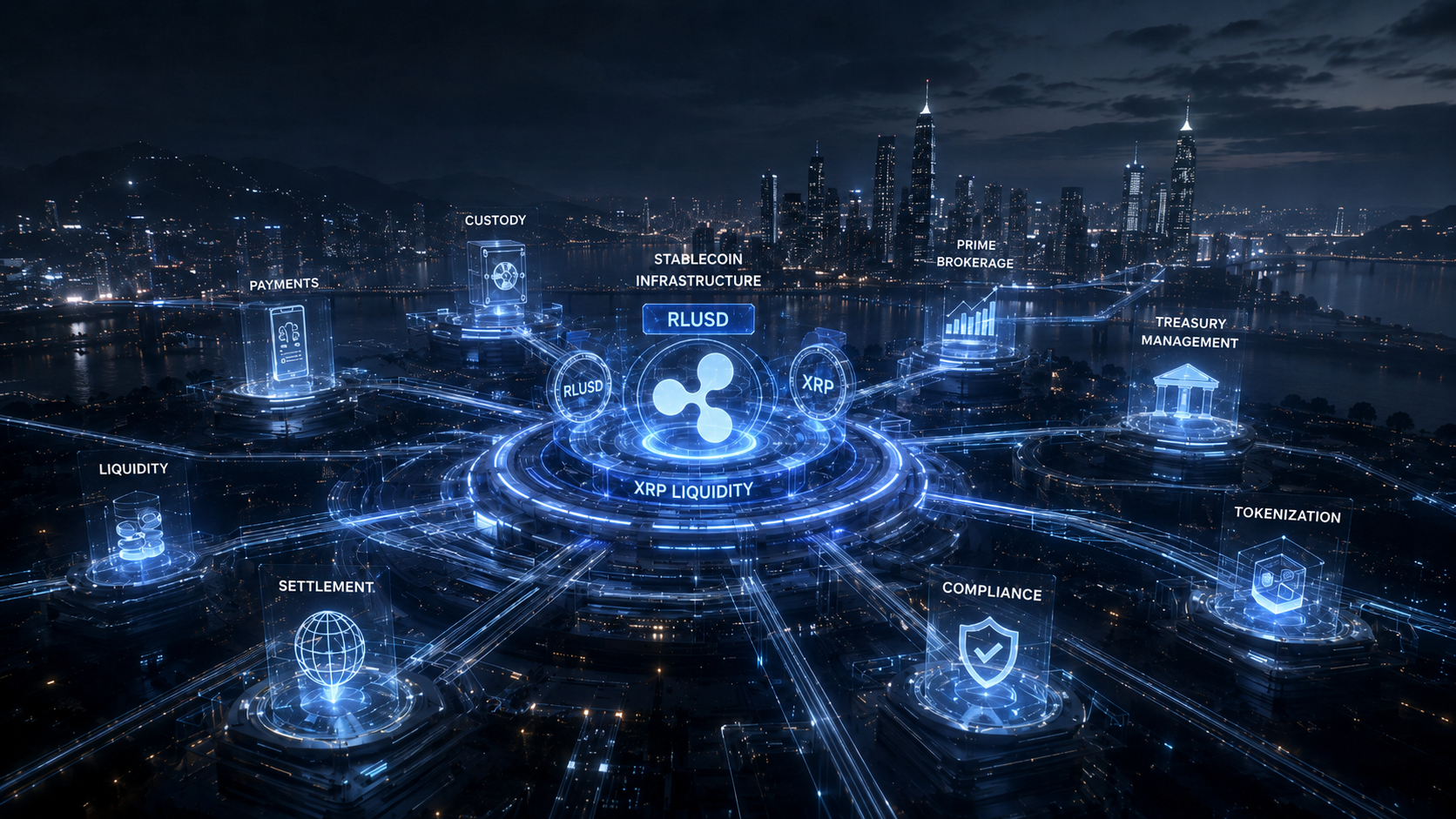
Over time, the company has assembled or expanded capabilities across:
- Payments
- Institutional custody
- Stablecoin infrastructure
- Liquidity
- Prime brokerage
- Treasury management
- Settlement infrastructure
- Tokenization
- Digital-asset connectivity
The SettleMint integration adds another connective layer.
Instead of Ripple Custody operating independently, it can now sit inside an institutional system capable of managing a financial asset from creation through settlement and ultimately through redemption or maturity.
That is an important evolution.
The strategy increasingly resembles the development of a full financial-infrastructure stack rather than a collection of unrelated products.
The individual pieces matter.
But the connections between those pieces may matter even more.
Where XRP and RLUSD Fit — and Where They Do Not Yet
This is where the analysis needs to remain precise.
Ripple Custody is capable of securing cryptocurrencies, stablecoins, and tokenized real-world assets. Ripple’s broader infrastructure ecosystem also includes XRP and the RLUSD stablecoin.
However, the September 1 announcement does not establish that XRP, the XRP Ledger, or RLUSD are required components of the SettleMint integration.
The companies did not disclose:
- Which blockchains initial customers will use
- Whether the XRP Ledger will be among those networks
- Whether RLUSD will serve as the cash or settlement leg
- Whether XRP will be used for liquidity or settlement
- Which institutions are already deploying the integration
- Expected transaction volumes
- Contract values
SettleMint itself is blockchain-agnostic and supports multiple deployment architectures.
For that reason, this announcement should not be described as direct XRP adoption.
There is currently no confirmed evidence from this announcement that the integration will create immediate XRP demand.
That does not make the development irrelevant to XRP.
It means the distinction between infrastructure expansion and confirmed asset utilization must remain clear.
Why This Still Matters to the XRP Thesis
The significance lies in the infrastructure being positioned around the asset ecosystem.
If Ripple continues embedding its technology into institutional payments, custody, treasury, brokerage, tokenization, stablecoin, and settlement environments, it increases the number of financial workflows in which Ripple-controlled or Ripple-connected infrastructure can operate.
That does not guarantee XRP utilization.
But it expands the number of places where XRP, XRPL, or RLUSD could eventually become useful if institutions decide those assets or networks provide an operational advantage.
That is why developments like the SettleMint partnership matter even when XRP is not explicitly named as a required settlement asset.
The infrastructure has to exist before large-scale institutional utilization can occur.
And Ripple continues building that infrastructure.
What Would Make This Development More Significant
The next major confirmation would be a named institution deploying the Ripple-SettleMint integration in a production environment.
The signal would become considerably stronger if that deployment involved a:
- Major bank
- Asset manager
- Exchange
- Central securities depository
- Financial-market infrastructure provider
- Sovereign institution
The most important technical details would then be whether the institution identifies:
XRPL as the underlying ledger
RLUSD as the settlement or cash asset
or
XRP as a liquidity, collateral, routing, or settlement component
Any of those disclosures would move the story beyond Ripple infrastructure expansion and toward much stronger evidence of Ripple Stack utilization — and potentially direct XRP utilization.
The Bottom Line
The SettleMint partnership is materially positive for Ripple’s institutional infrastructure footprint.
It strengthens Ripple Custody by embedding it inside a broader tokenized-asset life-cycle platform and gives Ripple another distribution path into regulated financial institutions operating across global capital markets.
It does not, at this stage, confirm direct XRP demand.
But it does reinforce a larger trend that is becoming increasingly difficult to ignore:
Ripple is steadily connecting payments, custody, stablecoins, liquidity, brokerage, treasury management, settlement, and tokenization into a broader institutional financial stack.
The individual announcements can look incremental when viewed separately.
Viewed together, they show something larger taking shape.
Ripple is not simply expanding products.
It is building a global infrastructure.