
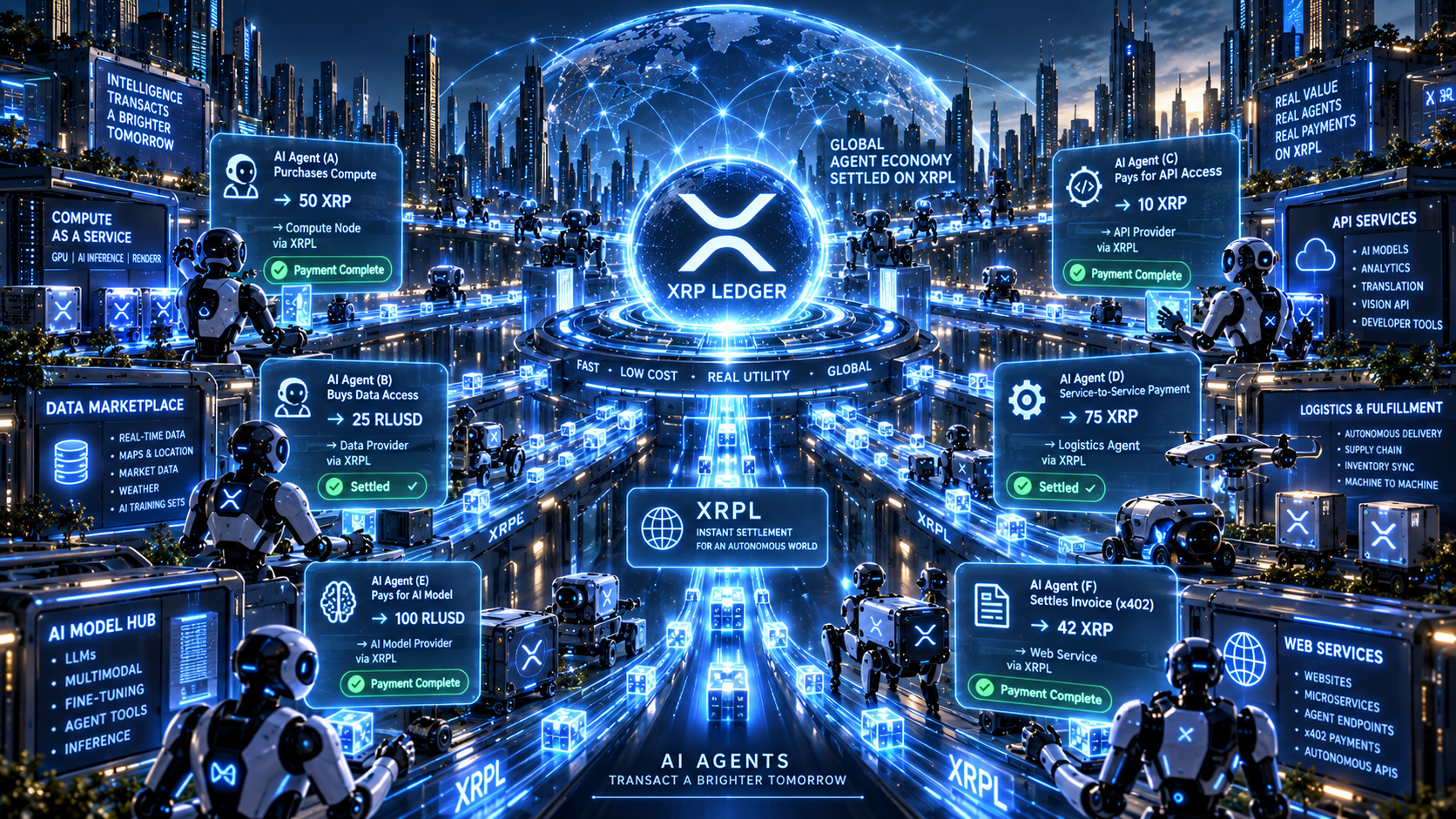
In my previous write-up on Ripple, the XRP Ledger and agentic payments, I focused primarily on the architecture: autonomous AI agents gaining the ability to purchase APIs, computing resources, data and other services through x402, with XRP and RLUSD providing payment and settlement options on the XRP Ledger.
That was largely a discussion about what this technology could enable.
Now we have enough live transaction data to begin asking a different question:
What happens if the XRP Ledger starts capturing a meaningful share of the emerging machine-to-machine payment economy?
The early numbers are beginning to make that question much more interesting.
XRPL Entered the x402 Race Late
That context matters.
Coinbase introduced x402 into production during 2025, and Base accumulated a substantial head start. Chainalysis reported in June 2026 that x402 activity on Base had already crossed 100 million cumulative transactions through the first quarter of 2026. (chainalysis.com)
Ripple did not formally launch the XRPL AI Starter Kit with x402-powered XRP and RLUSD payments until June 9, 2026. Ripple specifically described the technology as infrastructure allowing AI agents to autonomously pay for APIs, computing resources and other digital services. (ripple.com)
That means XRPL entered this particular race substantially later than Base.
Yet as of September 7, the live XRPL AI Hub shows:
4,361,190 x402 transactions
150 registered merchants
5,813.35 XRP settled
4,032.04 RLUSD settled
and a current seven-day average of 189,065 payments per day. (xrpl-ai.org)
For an implementation that only formally launched about three months ago, I do not consider that insignificant.
I consider it the beginning of a measurable adoption curve.
The Growth Rate Is What Has My Attention
The cumulative 4.36 million transactions are useful because they prove the system is actually being used.
But the number that interests me more is the rate.
During several checks of the dashboard on September 7, I watched the displayed seven-day average move from roughly 155,000 transactions per day, to approximately 172,000, and then to 189,065 per day.
From approximately 155,000 to 189,065 represents an increase of about 22% in the displayed seven-day average.
That does not mean actual transaction traffic suddenly exploded 22% during the few hours I was watching it. A seven-day rolling average can move as high-volume periods enter the calculation and lower-volume periods fall out.
But it does tell me that this is not simply a cumulative counter slowly climbing at a fixed rate.
The recent activity rate itself is worth watching.
At 189,065 transactions per day, the current pace annualizes to approximately:
69 million x402 transactions per year.
That brings us to an interesting threshold.
To reach a 100-million-transaction annual run rate, XRPL would need approximately:
273,973 x402 transactions per day.
That is only about 45% above the current seven-day average.
Put differently, the phrase “100 million transactions per year” sounds enormous.
But from where XRPL sits today, the daily rate required to support that number is no longer remotely outlandish.
Base Still Has the Historical Lead — But Solana Proves Leadership Can Change
This is where the competitive picture becomes important.
Base was the early x402 leader and still owns a massive cumulative head start.
But current activity demonstrates that being first does not guarantee permanent dominance.
x402Lens currently reports approximately 30.2 million payments during the trailing 30 days in its market overview. Of those:
Solana: 21.8 million payments
Base: 8.5 million payments
Solana therefore currently shows more than two-and-a-half times Base’s transaction count in that dataset, although Base still shows greater dollar settlement volume: approximately $838,600 on Base versus $496,000 on Solana. (x402lens.com)
A second tracker, x402beat, uses a much stricter methodology that only counts settlements it can positively attribute to x402 through published facilitator wallets or canonical x402 contracts.
Its latest 30-day verified dataset showed:
Solana: 8.7 million settlements
Base: 2.3 million
Polygon: 1.9 million
Monad: 579,700
Solana represented approximately 65% of the verified transactions in that particular dataset. (x402beat.org)
The exact numbers differ because the trackers use different methodologies.
That is important, and I would not pretend otherwise.
But both datasets point in the same direction:
x402 network leadership can shift.
Base’s enormous first-mover advantage did not prevent Solana from becoming the current transaction-count leader in these recent measurements.
And that is exactly why XRPL’s growth rate matters.
XRPL does not need to immediately overcome Base’s cumulative history.
It first needs to demonstrate that it is gaining a larger percentage of new x402 activity over time.
XRPL Is Still Behind — But It Is Now in the Race
Solana’s own x402 page currently advertises more than 37 million transactions and more than 20,000 buyers and sellers on its network. (solana.com)
XRPL’s approximately 4.36 million cumulative transactions therefore remain much smaller.
That should be acknowledged plainly.
But XRPL’s current seven-day rate of 189,065 transactions per day is already large enough that I no longer consider it an experimental rounding error.
If the present pace simply remained flat, XRPL would process approximately 5.7 million x402 payments every 30 days.
More importantly, if that daily average continues climbing, the competitive picture begins changing quickly.
This is why I intend to watch market share rather than cumulative totals alone.
Base started earlier.
Solana accelerated later.
XRPL entered later still.
The question is what happens next.
AI Agents Could Eventually Choose the Rail
This may be the most important part of the entire discussion.
x402 itself is designed to support multiple acceptable payment methods.
Under the x402 specification, a server can return an accepts array containing different payment requirements, including the network, asset and amount. The client then selects one of the payment requirements that it can satisfy. (github.com)
That means the payment network does not necessarily have to be permanently hard-wired into every transaction.
Today, developers and spending policies will frequently determine which network an agent uses.
But increasingly sophisticated agentic systems could eventually evaluate available payment routes using criteria such as:
transaction cost, settlement speed, deterministic finality, liquidity, asset availability, reliability and operational risk.
That creates an intriguing possibility.
An AI agent does not need to be an XRP enthusiast.
It does not care about blockchain tribalism.
It does not care which crypto community has the loudest social-media presence.
A properly configured machine can simply ask:
Which permitted payment route completes this task most efficiently?
If XRPL repeatedly produces a favorable answer, then some adoption could eventually become performance-driven rather than marketing-driven.
That is an important distinction.
I am not claiming there is evidence today that millions of autonomous agents have independently benchmarked Base, Solana and XRPL and are abandoning the others for XRP Ledger.
There is no evidence supporting that conclusion yet.
The current growth could result from new developer integrations, new services, facilitators, incentives or applications explicitly configured to use XRPL.
But x402’s architecture makes automated network selection technically possible.
That makes future routing behavior a metric worth watching.
Machines Can Generate Transactions Differently Than Humans
This is another reason I believe agentic payments deserve attention.
Traditional payment adoption normally grows according to the number of human users, businesses or institutions making payments.
Agentic systems change that relationship.
A person may give an AI system one instruction:
Research this problem and return the answer.
Behind that one human request, an autonomous agent could potentially:
purchase several datasets,
query multiple APIs,
buy AI inference,
purchase computing resources,
perform compliance checks,
pay another specialized agent,
acquire additional information,
and settle each service independently.
The human experiences one task.
The underlying payment network could experience dozens of economic transactions.
Then Agent A may purchase a service from Agent B.
Agent B may purchase computing resources from Agent C.
Agent C may acquire data from Agent D.
Economic activity becomes machine-to-machine and potentially recursive.
That is where transaction counts can begin scaling differently from traditional human-directed payments.
The Linux Foundation formally launched the x402 Foundation on July 14, 2026 with approximately 40 member organizations, describing x402 as an open standard allowing AI agents, APIs and applications to send and receive payments directly through internet interactions. (linuxfoundation.org)
This is no longer simply Ripple experimenting with an interesting AI feature.
There is a broader industry effort underway to create a native payment layer for autonomous software.
USDC Is Currently the Asset to Beat
Another number needs to be included because it provides important competitive context.
Circle reported that, as of July 2026, approximately 99.3% of x402 agent-payment settlement volume was occurring in USDC. (circle.com)
That is overwhelming dominance.
So XRP and RLUSD are not entering an evenly divided payment market.
USDC currently owns most of it.
But that also tells us exactly what needs to be measured going forward.
The question is not merely:
Is XRPL growing?
The better questions are:
Is XRPL gaining a larger percentage of x402 transactions?
Is RLUSD gaining settlement share?
Is XRP increasingly being used directly for machine payments?
Are services beginning to offer XRPL alongside Base and Solana?
When multiple networks are available, which one does the agent select?
Those measurements would tell us whether XRPL is simply benefiting from the overall expansion of agentic commerce or actually taking market share within it.
XRP Burn Is Small — But It Is Real and Cumulative
Agentic transactions also add another component to XRP utilization.
Every standard XRP Ledger transaction requires a transaction cost denominated in XRP.
The normal minimum is currently 10 drops, or 0.00001 XRP, and that XRP is not paid to Ripple or validators.
It is irrevocably destroyed. (xrpl.org)
That means even a transaction whose principal payment asset is RLUSD still consumes a small amount of XRP at the ledger level.
At today’s minimum standard transaction cost, the scale looks approximately like this:
100 million transactions = 1,000 XRP destroyed
1 billion transactions = 10,000 XRP destroyed
10 billion transactions = 100,000 XRP destroyed
These are not astronomical numbers relative to XRP’s total supply.
I am not arguing that transaction-fee burn by itself suddenly creates an XRP supply crisis.
That would be an exaggeration.
The point is simpler:
more XRPL adoption produces more aggregate XRP destruction than would otherwise occur.
That destruction is permanent.
As human payments, institutional settlement, tokenized assets, RLUSD transfers and machine-generated x402 payments all increase, the cumulative burn rate necessarily increases with the transaction activity, assuming those interactions continue settling on-ledger.
Small does not mean irrelevant.
It means cumulative.
What x402 Does — and Does Not — Prove About XRPL Throughput
Ripple and XRPL documentation have long referenced the XRP Ledger’s ability to sustain approximately 1,500 transactions per second in benchmarking. (xrpl.org)
The current x402 numbers do not prove that XRPL Mainnet is presently processing 1,500 transactions per second.
That distinction matters.
At the current seven-day x402 rate of 189,065 transactions per day, x402 itself is averaging only about 2.2 transactions per second.
But these transactions are additive to the XRP Ledger’s existing payments, DEX activity, token transfers, RLUSD activity, trust-line operations, institutional settlement and other ledger functions.
So the more useful observation today is:
XRPL is beginning to absorb an entirely new category of machine-generated workload while continuing normal ledger operations.
And the scaling math becomes interesting quickly.
A sustained:
100 million x402 transactions per year = approximately 3.17 TPS
1 billion per year = approximately 31.7 TPS
10 billion per year = approximately 317 TPS
Those figures would still exist alongside every other form of XRPL transaction activity.
That is why the long-term question is not simply whether XRPL can process today’s 4 million x402 payments.
The real question is what the ledger looks like if autonomous economic activity eventually begins generating billions of transactions per year.
Regulatory Clarity Still Matters to the Larger Picture
The regulatory environment surrounding Ripple and XRP is also substantially different from the environment in which x402 first began gaining traction in 2025.
The SEC and Ripple dismissed their respective appeals on August 7, 2025, resolving that appellate fight and leaving the district court’s final judgment in place. (sec.gov)
The broader U.S. digital-asset market-structure question is still unfinished.
The Senate Banking Committee advanced the Digital Asset Market CLARITY Act by a 15-9 vote on May 14, 2026, sending it toward the Senate floor. (banking.senate.gov)
As of September 7, the legislation has not yet become law, and a procedural Senate vote is scheduled for September 15. (reuters.com)
I believe that distinction matters.
XRPL’s x402 adoption is already happening before the United States has completed its broader digital-asset market-structure framework.
If clearer rules subsequently encourage additional financial institutions, fintech companies, developers and enterprises to build on digital-asset infrastructure, that would expand the environment in which XRPL, XRP and RLUSD compete for utilization.
Whether that results in the level of adoption I expect remains to be seen.
But the environment is moving in a very different direction than it was several years ago.
The Ripple Stack Now Has Another Measurable Layer
I have repeatedly described Ripple’s development as something larger than a payment company.
The emerging stack increasingly includes:
asset tokenization,
institutional custody,
stablecoin settlement through RLUSD,
payments infrastructure,
liquidity,
prime brokerage,
treasury management,
collateral and credit infrastructure,
XRPL settlement,
and now machine-generated payments through x402.
That final layer is different because it potentially creates an entirely new category of economic participant.
Not just people.
Not just corporations.
Not just banks.
Autonomous software.
And software can transact continuously.
What I Am Watching Next
The milestone I care about next is not simply when the dashboard flashes 5 million transactions.
That will happen eventually if current activity continues.
I am watching for something more meaningful:
274,000 transactions per day.
That would place XRPL at approximately a 100-million-x402-transaction annual run rate.
From the current seven-day average of 189,065, XRPL is only about 45% away.
After that, I will be watching whether XRPL begins taking a progressively larger percentage of the overall x402 market from Base, Solana and other supported networks.
I also want to see whether XRP and RLUSD settlement amounts begin increasing faster than transaction counts, which would indicate that agentic commerce is moving from extremely small micropayments toward greater economic value.
And perhaps most importantly, I will be watching for evidence that autonomous systems offered multiple payment options are actually selecting XRPL because its cost, speed, liquidity or deterministic settlement characteristics make it the preferable route.
If that happens, the thesis changes substantially.
At that point XRPL would not merely be another blockchain that developers configured to support AI agents.
It would be a network that machines themselves were increasingly choosing to use.
Bottom Line
Base started the x402 race earlier and built a massive cumulative lead.
Solana subsequently demonstrated that network leadership is not permanent.
Now XRPL has entered the race.
Approximately three months after Ripple formally launched x402 support through the XRPL AI Starter Kit, the XRP Ledger has already recorded more than 4.36 million indexed agentic transactions, with its recent seven-day rate sitting around 189,000 transactions per day. (xrpl-ai.org)
That does not prove XRPL will overtake Base.
It does not prove it will overtake Solana.
And it does not prove autonomous agents are already abandoning competing networks and choosing XRPL.
But it does establish something worth monitoring:
XRPL started later, it is processing real x402 activity, and its transaction rate is growing quickly enough that its share of the emerging machine-payment economy can now be measured.
That is the race I intend to watch.
Because if agentic commerce develops the way many technology companies expect, the future payment network may not be selected by the person making a purchase.
It may be selected in milliseconds by software deciding which rail performs the job best.
And if the XRP Ledger consistently performs well in that calculation, the 4 million transactions we are watching today may eventually look very small.
Data-Methodology Disclosure
The transaction figures referenced in this article come from multiple public dashboards, company disclosures and research sources that do not all use identical counting methodologies. That limitation matters.
The XRPL figures are drawn primarily from the XRPL AI Hub and reflect the x402 activity indexed by that platform, including transactions attributed to the T54 facilitator and related XRPL x402 infrastructure. Those figures should not automatically be interpreted as a complete census of every possible agentic payment occurring anywhere on XRPL.
The Base, Solana and other cross-chain figures come from sources such as x402Lens, x402beat, Chainalysis, Solana and other ecosystem disclosures. Some trackers use broad attribution techniques, while others count only transactions they can positively associate with known facilitator wallets, canonical contracts or other identifiable x402 fingerprints.
As a result, figures from different dashboards should not be treated as perfectly interchangeable or directly additive.
For that reason, I use these datasets primarily to evaluate:
direction of growth,
relative transaction intensity,
changes in network leadership,
reported settlement volume,
and whether multiple independent datasets point toward the same broader trend.
Where I annualize a daily or seven-day transaction rate, that calculation is a run-rate projection, not a claim that the same rate will persist for the next 12 months.
Where I compare XRPL with Base, Solana or another network, I distinguish between cumulative historical totals and recent transaction rates. A network that launched earlier naturally has an advantage in cumulative totals, while recent daily or 30-day rates are more useful for evaluating current momentum.
I also do not treat rising XRPL x402 activity as proof that autonomous AI agents are independently choosing XRPL over competing networks. Such a conclusion would require evidence that agents were actually presented with multiple acceptable settlement options and selected XRPL based on factors such as cost, speed, liquidity, reliability or deterministic finality.
In short, the data is useful, but it should be interpreted as an evolving measurement of a young market rather than a perfectly standardized global accounting system.