
ACI Worldwide, Ripple, and the Payment Infrastructure Snowball People May Be Missing
Sometimes the significance of a development is not found in what has already happened. It is found in where the infrastructure is being positioned and what becomes possible once that infrastructure begins carrying meaningful volume.
That is why I believe the recent developments involving ACI Worldwide, SWIFT, and Ripple deserve considerably more attention than they are receiving.
ACI Worldwide is not some small payment startup experimenting with blockchain.
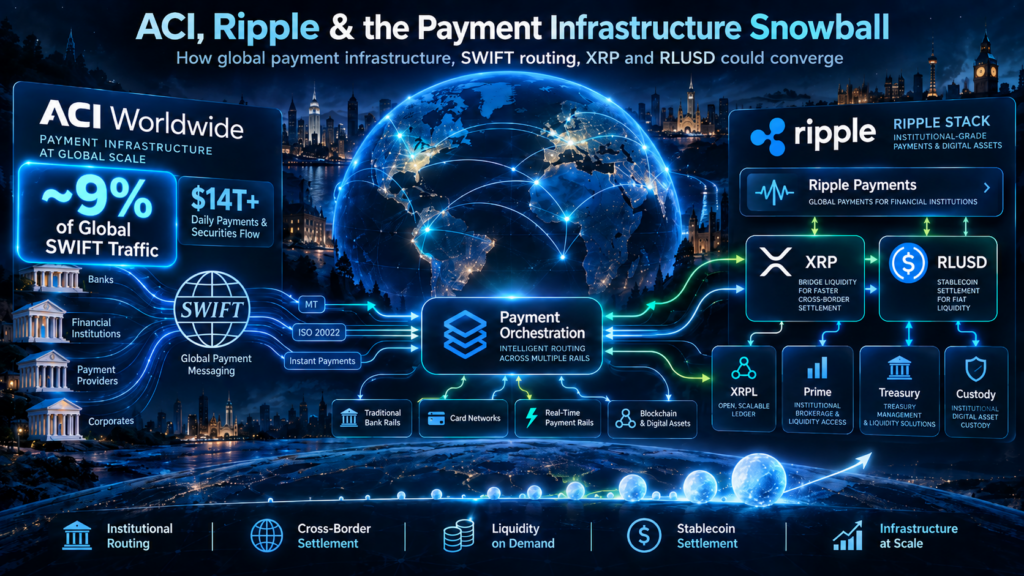
ACI says it supports approximately 9% of global SWIFT traffic and roughly 30% of SWIFT traffic in the United States. More importantly, ACI’s own website specifically lists distributed ledger technology — including Ripple — among the technologies its real-time payment systems can support alongside SWIFT FIN, SWIFT gpi, wires and immediate payments. (aciworldwide.com)
Then, on September 22, 2026, ACI announced that its ACI Connetic payments hub is being expanded to support payments orchestrated through SWIFT’s blockchain-based ledger, with intelligent routing that can determine appropriate clearing and settlement paths while allowing traditional and tokenized payments to operate within the same infrastructure. (investor.aciworldwide.com)
That combination is what has my attention.
The Real Story Is Bigger Than One Headline
I do not believe the most important takeaway is simply:
“ACI supports Ripple.”
The bigger issue is what ACI represents.
ACI is payment infrastructure sitting between banks, financial institutions, payment networks and settlement systems.
This is a company whose technology already touches a meaningful percentage of global financial traffic.
And according to ACI’s current website, its systems enable more than 225 billion consumer transactions per year and $14+ trillion in payments and securities transactions every day. (aciworldwide.com)
Read that number again:
More than $14 trillion per day.
That $14+ trillion figure is not the dollar value of ACI’s 9% share of SWIFT traffic. Those are two separate ACI statistics, and they should not be mixed together as though they measure the same thing.
But they tell us something extremely important about the scale of the company Ripple technology is potentially being positioned alongside.
And that is where the math starts getting interesting.
What Happens If Ripple Captures Even a Small Percentage?
Nobody currently knows what percentage of ACI-related payment activity could eventually involve Ripple Payments, XRP, RLUSD, XRPL or some combination of them.
So this is scenario analysis — not a claim about present transaction volume.
But consider the numbers.
Using ACI’s published $14+ trillion per day figure as a modeling denominator:
1% = $140+ billion per day
5% = $700+ billion per day
10% = $1.4+ trillion per day
Again, I am not saying Ripple currently processes those amounts through ACI.
I am asking a different question:
What happens if Ripple eventually becomes sufficiently integrated into infrastructure like ACI that it captures a meaningful portion of eligible transaction flows?
Because even what sounds like a small percentage becomes enormous when the underlying infrastructure operates at this scale.
And I consider 1% extraordinarily conservative as a long-term hypothetical if the technology actually proves faster, cheaper, reliable and attractive to institutions.
At 10% of that separate $14 trillion daily ACI transaction figure, the hypothetical becomes:
$1.4 trillion per day.
Annualized mathematically, that is approximately:
$511 trillion per year that Ripple could potentially be processing payments for.
That number should immediately change the way people think about what “institutional adoption” could eventually mean.
Now Add XRP and RLUSD
This is another place where I believe people make the mistake of treating XRP and RLUSD as though one must eliminate the need for the other.
I do not believe that.
I believe they can be complementary pieces of the same infrastructure.
Ripple’s own documentation says On-Demand Liquidity uses XRP as a bridge currency, sourcing liquidity on demand and moving funds in real time without requiring institutions to pre-fund destination markets. (docs.ripple.com)
Ripple also continues to describe XRP and other digital assets as bridge currencies within Ripple Payments. (ripple.com)
At the same time, Ripple is increasingly integrating RLUSD into institutional payment and settlement infrastructure.
In June 2026, for example, Ripple and Bitso announced an expanded arrangement in which Bitso’s MXNB peso stablecoin and Ripple’s RLUSD would support enterprise liquidity and settlement across the U.S.–Mexico corridor using XRPL infrastructure. (ripple.com)
That is precisely why I do not look at this as:
XRP versus RLUSD.
I look at it as:
XRP + RLUSD + XRPL + Ripple Payments + institutional liquidity infrastructure.
Different transactions may require different tools.
A dollar-denominated settlement may favor RLUSD.
A transaction requiring a neutral bridge between two different fiat currencies may benefit from XRP liquidity.
Other transactions may combine stablecoins, fiat, XRP and local payment rails.
The important thing is that Ripple is assembling the infrastructure capable of participating in all of those flows.
Run the Hypothetical One Step Further
Suppose, only for illustration, that Ripple eventually handled $1.4 trillion per day of transaction value through infrastructure connected to ACI.
Then suppose the resulting mix were:
50% stablecoin/RLUSD-related settlement
and
50% XRP-based bridge liquidity.
That would represent:
$700 billion per day associated with XRP bridge settlement
and
$700 billion per day associated with the other side of the Ripple payment architecture.
Change the percentage mix however you want.
30% XRP.
20% XRP.
10% XRP.
When the denominator becomes large enough, even the minority portion becomes enormous.
And that is one of the central points I have been making about XRP for years.
The XRP price thesis cannot be examined only by looking at today’s retail trading volume.
You have to consider what happens if XRP begins functioning at scale as institutional liquidity infrastructure.
At hundreds of billions of dollars of legitimate daily bridge activity, XRP markets would require substantially deeper liquidity.
That would mean deeper order books, more market makers, more institutional inventory, more geographically distributed liquidity and significantly greater dollar-denominated depth.
The same XRP can certainly be reused throughout the day because settlement occurs quickly.
But high velocity does not eliminate the requirement for liquidity.
You cannot move enormous amounts of value through shallow markets without slippage becoming unacceptable.
That is why genuine institutional XRP settlement volume matters.
But ACI Is Only One Company
This may actually be the most important part of the entire discussion.
ACI touches roughly 9% of global SWIFT traffic.
That sounds enormous — because it is.
But turn the statement around:
ACI is still only one payment infrastructure provider.
There is another 91% of global SWIFT traffic outside ACI’s approximately 9% share.
What happens if Ripple’s technology works extremely well within infrastructure like ACI?
What happens if banks using that infrastructure experience faster settlement, reduced capital requirements, improved liquidity management or lower costs?
What happens when another payment infrastructure provider notices?
And another?
That is where the snowball potentially begins.
One major infrastructure provider integrates or supports the technology.
Its customers use it.
The technology proves itself.
Transaction volumes increase.
Liquidity deepens.
The economics improve.
Other institutions notice.
Other infrastructure providers begin offering similar capabilities.
Additional corridors open.
Additional currencies enter the system.
Volume produces liquidity.
Liquidity improves utility.
Utility attracts more volume.
That is the potential feedback loop.
And we have already seen historical precedent for Ripple pursuing exactly this type of distribution strategy.
In 2019, Ripple announced a partnership with Finastra, another major financial software company. Ripple said Finastra customers would gain access to RippleNet and specifically stated that customers would have the option of using On-Demand Liquidity, leveraging XRP for cross-border payments. (ripple.com)
So the idea of Ripple getting into the financial system through large technology intermediaries is not new.
What may be changing is the scale and maturity of the infrastructure surrounding it.
This Is Why I Have Never Believed Ripple Needed to Replace SWIFT
I have never believed Ripple needed to destroy or replace SWIFT for XRP to succeed.
That has never been my thesis.
I believe Ripple technology can operate alongside SWIFT and within the broader financial infrastructure connected to SWIFT.
That is a much more realistic path.
SWIFT can continue handling messaging and orchestration.
Banks can continue using their existing systems.
Companies such as ACI can continue operating payment hubs.
And underneath or alongside those systems, Ripple can potentially provide liquidity, digital-asset settlement and alternative payment rails where those tools make economic sense.
In fact, ACI’s own language supports precisely this type of multi-rail environment.
ACI says its systems can support:
SWIFT FIN
SWIFT gpi
DLT, including Ripple
wires
and
immediate payments. (aciworldwide.com)
That does not look like a world where one technology kills everything else.
It looks like a world where intelligent software chooses among multiple financial rails.
And Ripple is positioning itself to be one of those rails.
The Ripple Stack Is Becoming Much Bigger Than Cross-Border Payments
This is also why I keep referring to what I call the Ripple Stack.
People who still look at Ripple as simply “the company behind XRP” are missing what has been built around it.
Today the stack includes areas such as:
Ripple Payments
XRP
XRPL
RLUSD
institutional custody
Ripple Prime
Ripple Treasury
liquidity infrastructure
tokenization
and other institutional financial services.
Ripple Prime alone currently reports more than $3 trillion in annual clearing activity across markets and more than 300 institutional customers. (ripple.com)
Ripple Treasury, built following Ripple’s acquisition of GTreasury, reported $13 trillion in customer payment volume during 2025, while its current platform advertises approximately $12.5 trillion in payments volume and connections to 13,000 banks. (treasury.ripple.com)
Those businesses should not simply be added together because they measure different types of financial activity.
But step back and look at what Ripple is assembling.
Payments.
Liquidity.
Stablecoins.
Bridge assets.
Custody.
Prime brokerage.
Treasury management.
Institutional trading infrastructure.
Blockchain settlement.
Tokenization.
This is becoming a vertically integrated financial infrastructure company.
And that is what I believe the market continues to underestimate.
Why the SEC Years May Have Changed Ripple
I was angry when the SEC sued Ripple.
I was also frustrated by how long the litigation dragged on.
But looking backward, I believe something else may have happened during that period.
Ripple had time to become a very different company.
Before the lawsuit, much of the discussion surrounding Ripple centered on XRP, RippleNet and cross-border payments.
The Ripple emerging on the other side is considerably broader.
Prime brokerage.
Enterprise custody.
Stablecoins.
Treasury management.
Tokenization.
Institutional liquidity.
Payments infrastructure.
XRPL development.
A complete financial technology stack.
I cannot prove that the lawsuit caused Ripple to develop this strategy.
But I can observe what Ripple became during and after that period.
Sometimes getting slowed down forces an organization to reevaluate the battlefield.
Instead of simply firing out of the barrel as quickly as possible, you get time to improve the weapon system.
That may ultimately prove to have mattered.
The Signal May Arrive Before Most People Recognize It
There is one final point that I believe is critical.
People often wait for confirmation so complete that the opportunity to recognize an emerging trend has already passed.
They want to see three major payment providers.
Then five.
Then ten.
They want to see enormous XRP transaction volume reported publicly.
They want to see banks announcing XRP usage individually.
They want financial television talking about it.
But by the time everybody sees the obvious signal, the early signal may have happened years earlier.
ACI may be one of those signals.
I am not claiming it proves Ripple will eventually process trillions of dollars per day.
It doesn’t.
I am saying something different:
Ripple is increasingly positioning its infrastructure at places where trillions of dollars already move.
That matters.
ACI says its systems touch more than $14 trillion in payments and securities transactions every day.
ACI says it supports approximately 9% of global SWIFT traffic.
ACI explicitly identifies Ripple as an example of DLT its payment systems can support.
ACI is now adding intelligent routing for payments involving SWIFT’s blockchain ledger.
Ripple already possesses an institutional payment network.
Ripple already possesses XRP-based On-Demand Liquidity technology.
Ripple now has RLUSD.
Ripple has custody.
Ripple has prime brokerage.
Ripple has treasury management.
Ripple has XRPL.
Those are individual dots.
Nobody can tell us conclusively today exactly how those dots will ultimately connect.
But I am human, and part of analysis is recognizing patterns before somebody publishes a press release explaining the completed picture to you.
My hypothesis remains that institutional utilization of Ripple Payments, XRP, RLUSD and the broader Ripple Stack is going to increase substantially as digital assets become integrated into traditional financial infrastructure.
ACI is not the end of that story.
ACI may simply be one more indication that the story has already started.
And if ACI proves to be only the first of several large payment infrastructure providers through which Ripple gains meaningful transaction flow, then the numbers people dismiss as unrealistic today may eventually need to be reconsidered against a completely different liquidity environment.
That is what I am watching.
Not whether Ripple replaces SWIFT.
Not whether every ACI transaction suddenly touches XRP.
I am watching where Ripple is being positioned, what infrastructure it now controls, what infrastructure it can connect to, and how much money already moves through those locations.
Because when infrastructure adoption begins to compound, things can get very big, very quickly.
AnthonyTankHall.com
Primary Sources
The Ripple Stack: Understanding the Bigger Picture Ripple Is Building – Tank’s Place
ACI Worldwide — ACI and SWIFT: ACI states that it supports approximately 9% of global SWIFT traffic and identifies Ripple as an example of supported DLT. ACI and SWIFT
ACI Worldwide — September 22, 2026 announcement on ACI Connetic and intelligent routing for payments orchestrated through SWIFT’s ledger. ACI Connetic and SWIFT Ledger Announcement
ACI Worldwide — Current company statistics showing 225+ billion annual consumer transactions and $14+ trillion in payments and securities transactions per day. ACI Worldwide Transaction Statistics
Ripple — Technical documentation explaining that On-Demand Liquidity uses XRP as a bridge currency. Ripple ODL Documentation
Ripple — Explanation of how XRP and digital assets function within cross-border payments. How Ripple Uses XRP for Cross-Border Payments
Ripple — Ripple and Bitso’s 2026 expansion involving RLUSD, MXNB and enterprise cross-border settlement. Ripple and Bitso Stablecoin Settlement Expansion
Ripple — 2019 Finastra partnership giving Finastra customers access to RippleNet and the option to use ODL with XRP. Ripple and Finastra Partnership
Ripple — Ripple Prime institutional prime brokerage statistics. Ripple Prime
Ripple Treasury — Enterprise treasury platform and transaction statistics. Ripple Treasury