

What the 2014 Epstein correspondence reveals about early pressure on Ripple/XRP, Stellar/XLM, and the investors backing them.
For years, people in the XRP community who questioned whether Ripple faced more than ordinary competition were routinely dismissed as conspiracy theorists.
I believe that conversation now deserves to be revisited.
Recently surfaced documents from the U.S. Department of Justice’s Epstein Library contain something far more consequential than another round of cryptocurrency tribalism: primary-source evidence showing influential participants in the early Bitcoin ecosystem applying coordinated financial pressure against investors who were also supporting Ripple and Stellar.
That does not prove every theory that has ever been raised about Ripple, XRP, the SEC, Bitcoin or Ethereum.
But it proves something important:
Ripple was viewed as a serious competitive threat extremely early, and people with money, access and influence were willing to pressure others financially because they supported it.
That is no longer speculation.
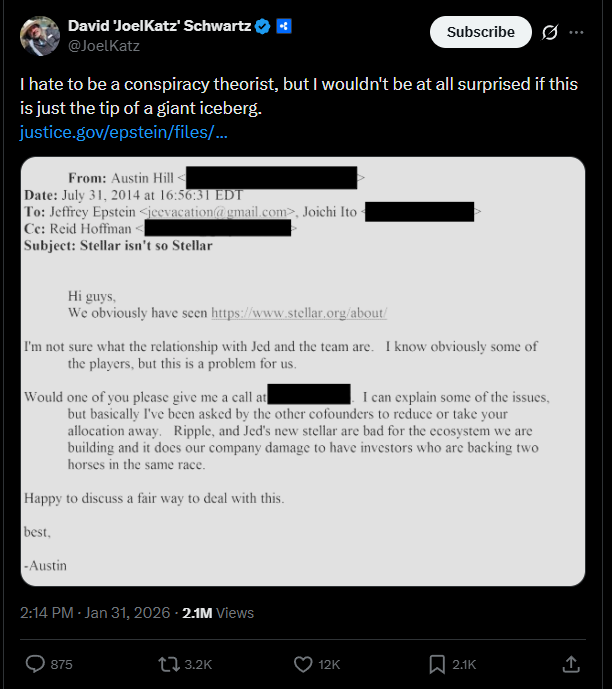
The 2014 Email
On July 31, 2014, Austin Hill, co-founder and then-CEO of Blockstream, sent an email to Jeffrey Epstein and Joichi “Joi” Ito, with LinkedIn co-founder Reid Hoffman copied.
The subject was:
“Stellar isn’t so Stellar.”
Hill’s complaint wasn’t simply about Stellar.
He specifically identified both Ripple and Jed McCaleb’s newly created Stellar network as competitive problems.
Hill wrote that:
“Ripple, and Jed’s new stellar are bad for the ecosystem we are building”
He also complained about investors:
“backing two horses in the same race”
And most importantly, Hill told the recipients that he had been asked by Blockstream’s other co-founders to:
“reduce or take your allocation away.”
That document is part of the DOJ’s released Epstein materials.
Think carefully about what that actually means.
This was not somebody writing an angry Bitcoin forum post.
This was the head of an emerging Bitcoin infrastructure company communicating with wealthy and extremely well-connected investors and effectively saying:
If you support Ripple and Stellar while investing with us, your financial participation with us may be reduced or removed.
That is economic pressure.
And according to Hill’s own words, he wasn’t acting solely on his personal opinion. He said the request came from other co-founders.
Call It What It Is: Coercion and Coordination
People are going to argue over terminology, so I want to be precise.
If someone wants to reserve the word “collusion” exclusively for a proven criminal, antitrust or regulatory violation, these documents do not establish that legal conclusion.
But in the ordinary meaning of the word—multiple people coordinating actions intended to disadvantage a competitor or those supporting that competitor—the evidence is difficult to ignore.
There is obvious coercive pressure and coordinated behavior contained directly in the correspondence.
Hill says other co-founders wanted investor allocations reduced or removed.
Why?
Because those investors were also supporting Ripple and Stellar.
The recipients didn’t simply ignore him either.
Reid Hoffman responded that he hadn’t anticipated the negative reaction and said he would speak with Hill. Joi Ito also indicated he would contact him.
Then, following the discussion, Ito wrote:
“Thanks for the call Austin.”
He told Hoffman and Epstein that they were “synced and OK” and said he had additional follow-up work intended to help “sync up Stellar and Blockstream.”
That is coordination.
You can debate how sinister the motivation was.
You cannot reasonably argue that the coordination did not occur.
Why Was Jeffrey Epstein Involved?
This is another part of the story that deserves attention.
Epstein was not simply a random recipient of the correspondence. Financial records released in the Epstein materials show that, weeks later, money connected to Epstein was used to fund an investment in Blockstream.
Financial records released in the Epstein materials document a September 9, 2014 transaction involving $500,001 from Southern Financial LLC, with the description:
“subcr to Kyara Investment III, LLC to fund Blockstream Investment.”
That provides important context.
These conversations involved people who had actual financial interests connected to Blockstream.
The significance isn’t that Jeffrey Epstein somehow controlled Bitcoin or personally orchestrated a campaign against Ripple. There is no evidence establishing that.
The significance is that the network of investors and technology figures surrounding early Bitcoin development included people with considerable wealth and influence—and Ripple was sufficiently threatening to their interests that continued financial support for Ripple and Stellar became an issue requiring intervention.
The Most Important Words May Be “Two Horses in the Same Race”
To me, one sentence in Hill’s email tells us more than almost anything else:
They were “two horses in the same race.”
That is extraordinarily revealing.
For years, critics portrayed XRP as irrelevant to Bitcoin.
A centralized “banker’s coin.”
A project supposedly incapable of competing with “real crypto.”
Yet in 2014, behind closed doors, one of the founders of an important Bitcoin infrastructure company was describing Ripple as another horse in the same race.
Blockstream itself publicly described its mission as extending the Bitcoin ecosystem through sidechains and increasing Bitcoin’s functionality. Its founders included Austin Hill, Adam Back and prominent Bitcoin developers.
Ripple represented a very different technological philosophy.
Instead of waiting for proof-of-work confirmation and attempting to transform Bitcoin into infrastructure capable of supporting broader financial applications, the XRP Ledger had already been designed specifically for the rapid transfer and exchange of value.
Settlement measured in seconds.
Extremely low transaction costs.
Native currency exchange.
No proof-of-work mining.
A system specifically suited for payments, liquidity and financial settlement.
For the mission Ripple was pursuing, XRP and the XRP Ledger were technologically formidable competitors.
The newly released correspondence demonstrates that people building another major cryptocurrency ecosystem recognized that competitive threat more than a decade ago.
Then Came the Regulatory Years
This is where the story becomes particularly interesting.
I have long believed that one of the most effective ways to suppress adoption of a financial technology isn’t necessarily to destroy it.
You simply make institutions afraid to touch it.
Banks don’t need XRP to actually be illegal.
Payment companies don’t need Ripple to actually lose a lawsuit.
Institutional investors don’t need regulators to formally prohibit XRP.
All that is necessary is sufficient regulatory uncertainty.
If a bank’s general counsel tells its executives:
“The SEC may eventually classify this asset as a security,”
the safest institutional decision is obvious:
Wait….
That delay itself can become an enormous competitive advantage for everybody building something else.
And XRP eventually entered exactly that regulatory environment.
Court records establish that XRP was added to the SEC’s internal Watch List on April 13, 2018. The SEC’s formal Ripple investigation followed on March 9, 2019.
Meanwhile, on June 14, 2018, then-SEC Corporation Finance Director William Hinman gave his now-famous speech explaining that, based on his understanding of Ethereum’s circumstances at the time, offers and sales of Ether were not securities transactions.
Then, on December 22, 2020, the SEC filed its enforcement action against Ripple, Brad Garlinghouse and Chris Larsen.
The lawsuit created exactly the type of institutional uncertainty that could delay adoption of Ripple technology and XRP for years.
That is indisputable.
What has not been proven is a direct evidentiary chain connecting Austin Hill, Blockstream, Jeffrey Epstein, Joi Ito, Reid Hoffman or any other person in the 2014 correspondence to the SEC’s later decision to sue Ripple.
I am not going to manufacture that bridge where the evidence doesn’t yet establish one.
But I also won’t pretend the earlier evidence is meaningless.
We now know that influential Bitcoin-aligned interests were willing to pressure investors because those investors were supporting Ripple and Stellar.
That makes the larger question considerably more legitimate:
How widespread was that attitude, and who else was subjected to similar pressure?
And Then Ripple Survived
Here is where this becomes decidedly bullish for me.
Imagine what Ripple has survived.
Competitive pressure from the earliest days of cryptocurrency.
Years of regulatory uncertainty.
A December 2020 SEC lawsuit that effectively hung a regulatory cloud over XRP in the world’s largest capital market.
Exchange delistings.
Institutional hesitation.
Years of litigation.
Constant attacks against XRP’s legitimacy.
And yet Ripple wasn’t destroyed.
Neither was XRP.
On July 13, 2023, Judge Analisa Torres made one of the most consequential findings in cryptocurrency case law:
XRP, as a digital token, is not in and of itself an investment contract.
The court also determined that Ripple’s programmatic XRP sales on exchanges were not investment contracts, while finding that certain direct institutional sales were securities transactions.
Then, on August 7, 2025, the SEC and Ripple dismissed their respective appeals, formally resolving the civil enforcement action while leaving the district court’s final judgment in place.
Ripple walked out the other side.
And look at what the company has become.
Today Ripple isn’t operating as some single-product cryptocurrency startup.
Its institutional infrastructure now encompasses:
payments, digital-asset custody, stablecoins, prime brokerage, treasury management and tokenization, while the XRP Ledger continues operating as infrastructure for moving and tokenizing value. Ripple currently advertises payment settlement in approximately three to five seconds and coverage reaching roughly 90% of the global foreign-exchange market.
That is an extraordinary evolution for a company and ecosystem that opponents supposedly believed could be marginalized.
Why I Believe This Is Bullish for XRP
The bullish argument isn’t:
“Jeffrey Epstein appears in an email, therefore XRP is going to the moon.”
That’s nonsense.
The real bullish conclusion is much more substantial.
Ripple mattered enough to threaten powerful competing interests before most of today’s cryptocurrency market even existed.
Remember: this happened in 2014.
Ethereum’s mainnet hadn’t even launched yet.
Institutional cryptocurrency custody barely existed.
Stablecoins hadn’t become a global settlement industry.
Tokenized real-world assets weren’t a major Wall Street strategy.
Banks weren’t building institutional blockchain platforms at today’s scale.
Yet people already building around Bitcoin were worried about Ripple.
That matters.
It suggests Ripple wasn’t fighting merely for cryptocurrency market share.
It was competing over something much larger:
What architecture would ultimately become part of the infrastructure used to move value in a digital financial system?
That battle continues today.
The Suppression Question Has Changed
I think we need to update the way this discussion is framed.
Previously, asking whether Ripple faced coordinated opposition from powerful interests required considerably more inference.
Today we possess primary-source documentation showing at least one clear example.
There were people with capital and influence.
They were financially connected to an important Bitcoin company.
Ripple and Stellar were explicitly considered competitors.
Support for those competing projects was considered harmful.
And investors were threatened with reduced or eliminated participation because they were backing them.
That is evidence.
Whether additional documents eventually establish connections to regulatory influence, lobbying, financial institutions, policymakers or other technology companies remains an unanswered question.
Perhaps they won’t.
Perhaps they will.
David Schwartz himself reacted to the documents by saying he wouldn’t be surprised if what had surfaced represented “the tip of a giant iceberg.”
I think that’s exactly the right way to approach this.
Don’t claim what hasn’t been proven.
But don’t ignore what has been proven either.
My Overarching Conclusion
After looking at this history, my view of Ripple and XRP is actually more bullish—not because of conspiracy theory, but because of competitive validation.
One of the strongest signals that you have developed something disruptive is when established interests begin treating you as a threat.
Ripple was being treated as a threat in 2014.
People were willing to apply financial leverage against individuals supporting it.
Years later, XRP became entangled in one of the most consequential regulatory battles in cryptocurrency history.
And after all of that, Ripple is still standing.
The XRP Ledger is still operating.
XRP obtained significant legal clarity.
Ripple survived the SEC litigation.
And the company has expanded far beyond its original payments business into a broader institutional digital-finance infrastructure stack.
Perhaps the most remarkable part of the story isn’t that powerful people tried to protect the ecosystem they were building.
Powerful people have always protected their financial interests.
The remarkable part is this:
They couldn’t make Ripple go away.
And if Ripple was important enough to worry powerful competitors in 2014—before blockchain finance became remotely comparable to what it is today—then the more important question may be what happens as Ripple, XRP, the XRP Ledger, stablecoins, tokenization and institutional digital-asset infrastructure move into the next phase of global adoption.
That, to me, is the bullish story.
Primary Sources and Further Reading
U.S. Department of Justice — Epstein Library: DOJ Epstein Library
July 31, 2014 “Stellar Isn’t So Stellar” correspondence: DOJ EFTA01915883 document
Follow-up correspondence regarding the reaction to Hill’s message: DOJ EFTA01854576 document
SEC’s December 22, 2020 Ripple enforcement announcement: SEC v. Ripple announcement
Judge Torres issued a split decision on July 13, 2023: SEC v. Ripple Labs
William Hinman’s June 14, 2018 digital-assets speech: SEC — Digital Asset Transactions: When Howey Met Gary (Plastic)
SEC’s August 7, 2025 announcement resolving the Ripple appeals: SEC — Ripple litigation resolution
Ripple’s current institutional financial-infrastructure platform: Ripple official website
David ‘JoelKatz’ Schwartz post on x.com referencing the Epstein emails:
This article represents analysis and opinion based on publicly available information and primary-source documents. It should not be construed as financial or investment advice.