
September 8, 2026
For years, much of the XRP discussion centered on what might eventually happen if digital assets became integrated into traditional finance.
In this case, there is nothing hypothetical about the financial structure.
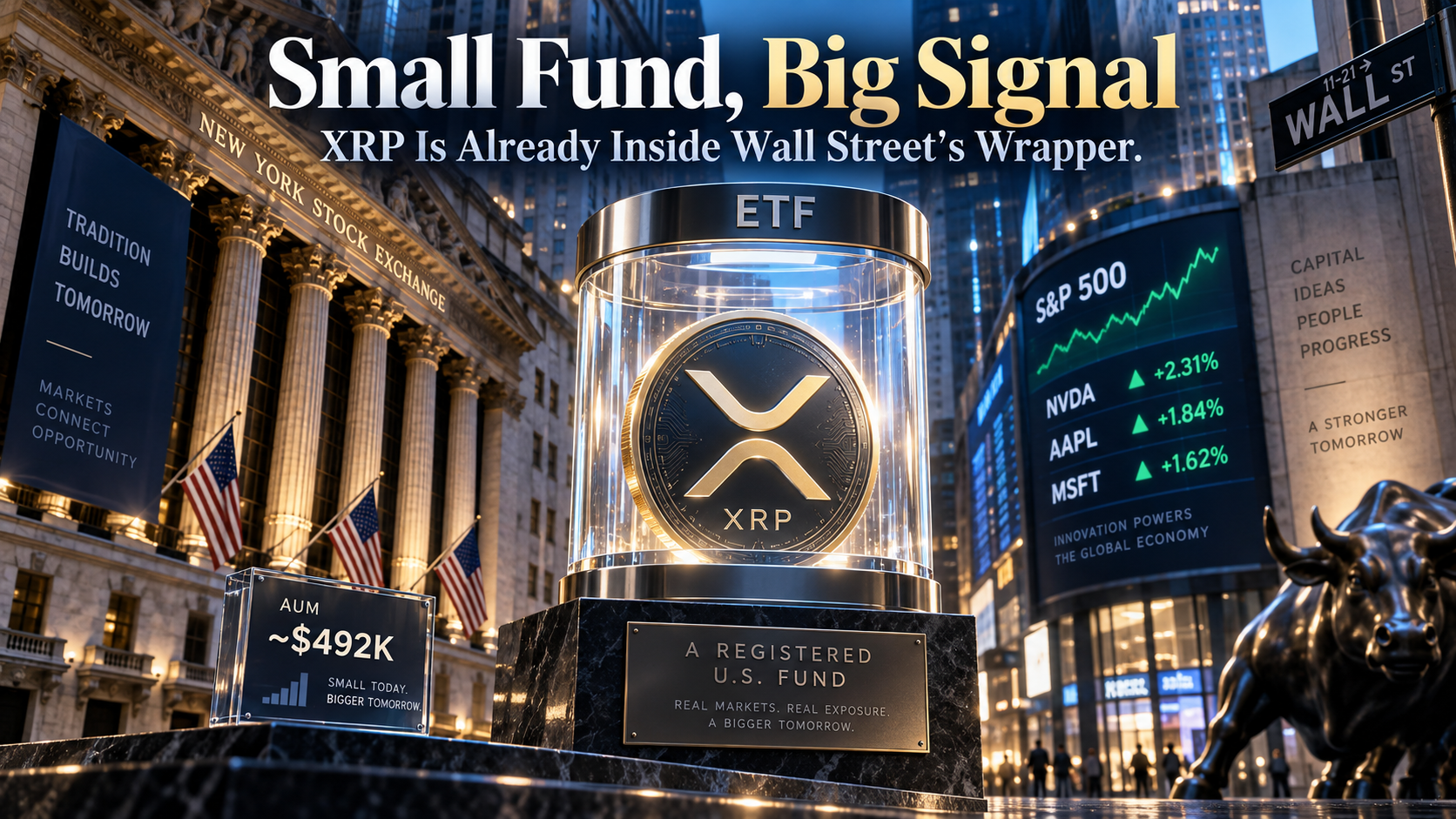
The Cyber Hornet S&P 500® and XRP 75/25 Strategy ETF, trading on Nasdaq under the ticker XXX, is a live U.S. exchange-traded fund designed to combine approximately 75% exposure to the S&P 500 with approximately 25% exposure to XRP. The fund commenced operations in January 2026 and operates as a series of Cyber Hornet Trust, a registered investment company.
And according to Cyber Hornet’s first semi-annual shareholder report for XXX, XRP was not merely referenced in the prospectus or held as some theoretical future allocation.
It was the fund’s largest individual holding.
That distinction is what makes this development worth examining.
First, Put the Size in Perspective
There is no reason to exaggerate what Cyber Hornet XXX currently represents financially.
As of June 30, 2026, the fund reported:
Net assets: $492,790
Number of holdings: 452
XRP allocation: 22.5% of net assets
NVIDIA: 6.1%
Apple: 5.2%
Alphabet: 4.7%
Microsoft: 3.3%
Those numbers come directly from Cyber Hornet’s semi-annual shareholder report covering the period from January 29 through June 30, 2026.
By September, Cyber Hornet reported approximately $550,000 in net assets for XXX. Its September 8 holdings showed 101,380 XRP, valued at approximately $141,877, representing 26.00% of the portfolio.
By Wall Street standards, $550,000 is tiny.
That needs to be stated plainly.
This is not BlackRock moving billions of dollars into XRP. It is not evidence that institutional capital has suddenly flooded into the asset. It is not, by itself, something likely to materially affect XRP’s global market price.
But that is also not the most important part of the story.
The significant part is the financial architecture that now exists around the asset.
XRP Is Sitting Beside America’s Largest Public Companies
Look at what the portfolio actually contains.
XRP sits in the same regulated investment vehicle as NVIDIA, Apple, Microsoft, Amazon, Alphabet, Broadcom, Meta and hundreds of other companies represented through the S&P 500 strategy.
That does not make XRP equivalent to common stock in those corporations.
It does demonstrate something different and important:
Traditional securities and a digital asset are now being packaged together inside the same U.S.-listed investment product.
The fund’s investment objective is to replicate, before fees and expenses, the performance of the S&P 500 and S&P XRP 75/25 Blend Index.
The SEC-filed prospectus describes that benchmark as a multi-asset strategy consisting of a 75% weighting in the S&P 500 Index and a 25% weighting in the S&P XRP Reference Price Index.
That alone represents a remarkable change from where the digital-asset industry stood only several years ago.
XRP is no longer simply an asset traded on cryptocurrency exchanges.
It can now exist within an investment structure recognizable to conventional investors, financial advisers, brokerage platforms and institutional infrastructure providers.
This Is More Than an ETF Ticker
The underlying structure is where this gets more interesting.
Cyber Hornet Trust is a registered open-end investment company, and the XXX shares trade on Nasdaq. The SEC filings identify the trust under Investment Company Act File No. 811-21836.
The XRP strategy is designed to invest directly in XRP while also allowing certain XRP-related products and derivatives as part of its implementation.
The regulatory architecture extends even further.
Cyber Hornet XXX wholly owns a subsidiary called CYBER HORNET XRP, organized under the laws of the Cayman Islands. Cyber Hornet’s SEC registration documents explicitly identify the XRP subsidiary and state that its financial statements are consolidated into the ETF’s annual and semi-annual reporting.
Cryptocurrency custody is also not being handled through an anonymous wallet sitting somewhere on a laptop.
Cyber Hornet’s SEC-filed prospectus identifies BitGo Bank & Trust, National Association as the cryptocurrency custodian for the funds and states that cryptocurrency assets are maintained in segregated custody accounts using cold-storage security measures.
Put the pieces together:
U.S. investor → brokerage account → Nasdaq-listed ETF → registered investment company → XRP investment structure → institutional cryptocurrency custody → direct XRP exposure
That is the signal.
Not $550,000.
The plumbing.
The S&P Connection Is Also Worth Paying Attention To
There is another detail that should not be overlooked.
The fund is not simply allocating 25% to XRP based on some internally created Cyber Hornet formula.
Its benchmark incorporates the S&P XRP Reference Price Index, and S&P Dow Jones Indices compiles and maintains the underlying index structure used by the strategy.
That should not be misrepresented as an endorsement of XRP by S&P Dow Jones Indices. Cyber Hornet’s own disclosures explicitly state that S&P does not sponsor, endorse, sell or promote the fund.
But there is still a meaningful difference between an asset existing only within the cryptocurrency ecosystem and that asset having pricing benchmarks incorporated into products built around mainstream financial indexes.
Again, this is about normalization and infrastructure, not endorsement.
This Is Not an SEC Endorsement of XRP
Another distinction matters.
The existence of the fund should not be described as the SEC “approving XRP.”
That is not what happened.
Cyber Hornet files its registration documents and shareholder reports with the SEC, and the fund operates under applicable securities and investment-company regulations.
The SEC’s own required disclosure language is explicit:
The Commission has neither approved nor disapproved the securities nor passed on the accuracy or adequacy of the prospectus.
That distinction matters because regulatory compliance and regulatory endorsement are two completely different things.
What can legitimately be said is much more precise:
A U.S.-registered investment-company structure containing direct XRP exposure is operational and trading on Nasdaq.
That claim is supported by the filings.
XRP Is Not the Only Digital Asset Getting This Treatment
Cyber Hornet has built similar S&P 500 blended strategies around Bitcoin, Ethereum and Solana, alongside XRP. Its current prospectus identifies the BBB, EEE, SSS and XXX funds and has subsequently added a broader Crypto Top 10 strategy.
Some XRP supporters may initially see that as diminishing the significance of XXX.
I see it differently.
The fact that XRP is being incorporated into the same investment-product architecture as Bitcoin, Ether and Solana demonstrates that it is participating in the broader institutionalization of digital assets rather than remaining outside of it.
In other words, XRP did not need some strange, XRP-specific financial exception.
It fit into the machinery being constructed for institutional digital-asset exposure.
That may ultimately be the more important development.
Small Funds Can Still Establish Large Precedents
Financial markets often focus on scale, and appropriately so.
A $500 million ETF deserves more attention from a capital-flow perspective than a $500,000 ETF.
A $5 billion ETF deserves even more.
But scale and structural significance are not always the same thing.
Before infrastructure can carry billions of dollars, somebody has to establish that the infrastructure can carry the first million.
Before there are dozens of investment products, somebody creates the first few.
Before an asset becomes routine inside financial portfolios, somebody has to build the custody relationships, benchmarks, legal entities, prospectuses, accounting procedures, brokerage access and exchange-traded wrapper necessary to make that possible.
That is why XXX is worth watching even though its current assets under management are small.
The rail exists.
It has investors.
It holds XRP.
It reports those holdings.
It trades publicly.
And it operates within a conventional U.S. investment structure.
The Larger XRP Institutionalization Story
This development also fits into a much larger transition taking place around XRP.
The asset has increasingly moved from a discussion dominated by cryptocurrency exchanges, retail speculation and regulatory litigation toward one involving custody, exchange-traded investment products, institutional treasury strategies, tokenization infrastructure, payment systems and regulated financial services.
Cyber Hornet does not prove that every component of that larger thesis will succeed.
It does not prove that institutions will eventually acquire billions of XRP.
It does not prove a particular future XRP price.
And it certainly does not prove that every financial institution intends to use XRP for payments, liquidity or settlement.
Those are separate questions requiring separate evidence.
What XXX demonstrates is narrower—but concrete:
There is already an operational bridge between XRP and conventional U.S. investment infrastructure.
That bridge does not need to be theorized about.
It can be found in an SEC filing.
It can be purchased through a Nasdaq-listed ticker.
And its XRP holdings can be found directly on the fund’s portfolio page.
The Signal Is the Structure
This is why focusing exclusively on Cyber Hornet’s small AUM misses the larger point.
If someone says:
“It’s only a half-million-dollar fund.”
They are correct.
But they are answering a different question.
The question is not whether Cyber Hornet XXX is currently large enough to move the XRP market.
It clearly is not.
The more interesting question is whether the financial infrastructure required to place XRP inside a conventional U.S. investment wrapper actually exists.
The answer to that question is yes.
A registered investment company can hold XRP exposure.
A Nasdaq-listed ETF can combine XRP with the S&P 500.
An S&P-developed XRP reference index can participate in the benchmark architecture.
Institutional custody can secure the underlying cryptocurrency.
The holdings can be independently reported to shareholders.
And ordinary investors can access the entire structure through a brokerage account using the ticker XXX.
That is considerably more consequential than the fund’s current $550,000 balance sheet might suggest.
Small fund. Big signal.
XRP is not standing outside the traditional financial system waiting for someone to build the door anymore.
The door is already open.
Primary Sources
Cyber Hornet XXX Fund Page and Holdings
Cyber Hornet XXX Semi-Annual Shareholder Report — June 30, 2026
SEC — Cyber Hornet Prospectus, July 29, 2026
SEC — XXX Summary Prospectus